Abisko keeps coming up when people plan a northern lights trip to Swedish Lapland. The hard part usually isn't the place, it's the dates. This post is about Abisko only: which weeks to book this winter, and how to pick the night once you're there.
The short answer: the moonless windows are December 4–13, January 1–10, January 29–February 8, and February 25–March 9. Below I cover how dark it gets, the moon, when in the night to be outside, clouds, and the Aurora Sky Station. Everything is calculated for Abisko's coordinates (68.3495° N, 18.8312° E), in local Stockholm time.
Why Abisko
Abisko sits in a rain shadow behind the mountains. According to SMHI, the Swedish Meteorological and Hydrological Institute, its normal annual precipitation for 1991–2020 is 347 mm, the lowest of any Swedish station. Weather records there go back to December 1912.
Precipitation isn't cloud cover, though. I couldn't find a published count of clear nights for Abisko, so I won't promise clear skies. What does help is that a Kp of about 1 is usually enough to see aurora overhead or to the north there. City-by-city numbers are in what Kp index you need to see the northern lights.
Moonless dates in Abisko, December 2026 – March 2027
Moon phases are below. All times are UTC.
- New moon: December 9, 2026, 00:52
- Full moon: December 24, 01:28
- New moon: January 7, 2027, 20:24
- Full moon: January 22, 12:17
- New moon: February 6, 15:56
- Full moon: February 20, 23:24
- New moon: March 8, 09:29
- Full moon: March 22, 10:44
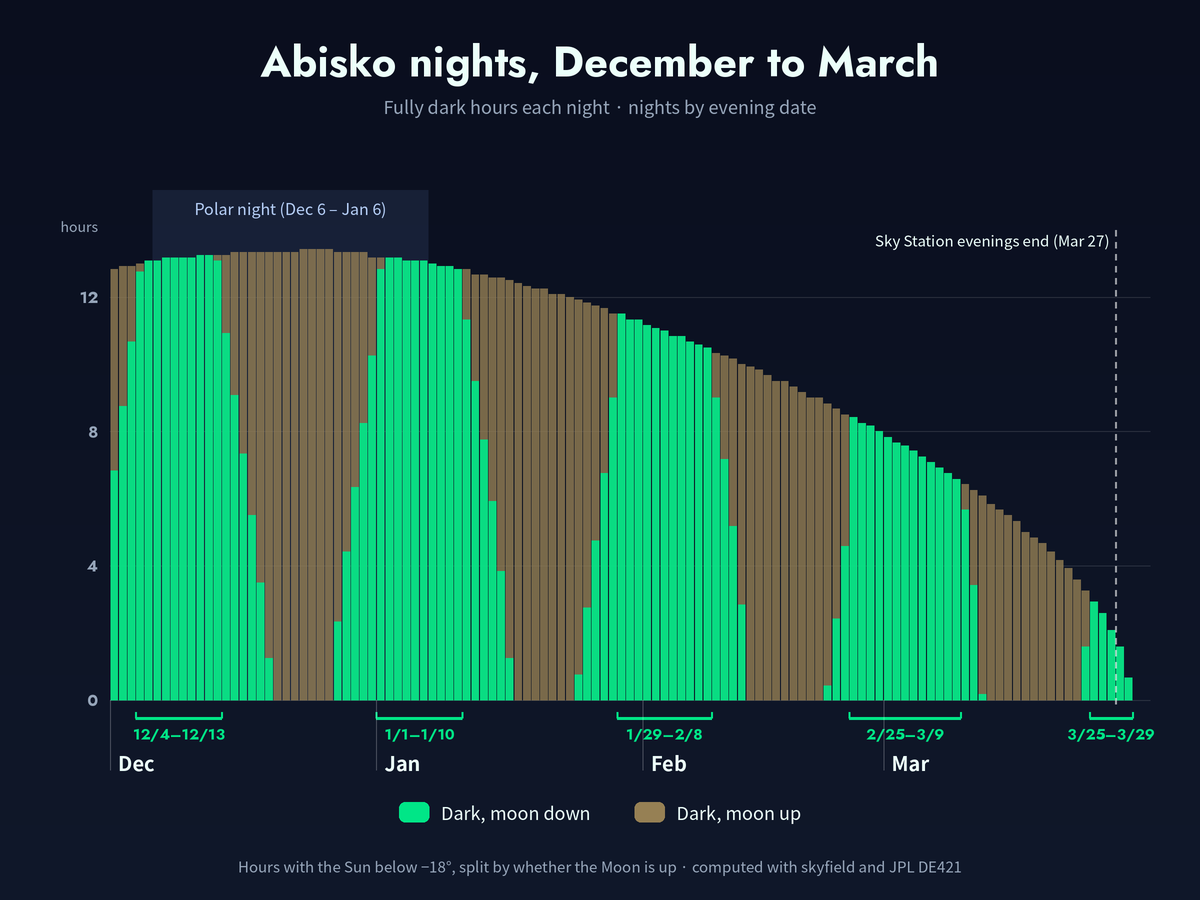
The phase matters less than whether the moon is above the horizon while it's dark. So I computed, in 5-minute steps, the fully dark hours (Sun more than 18° below the horizon) and counted a night as moonless when at least 90% of those hours have the moon below the horizon. Dates are the evening the night starts. I used Python Skyfield with NASA JPL's DE421 ephemeris.
Best nights
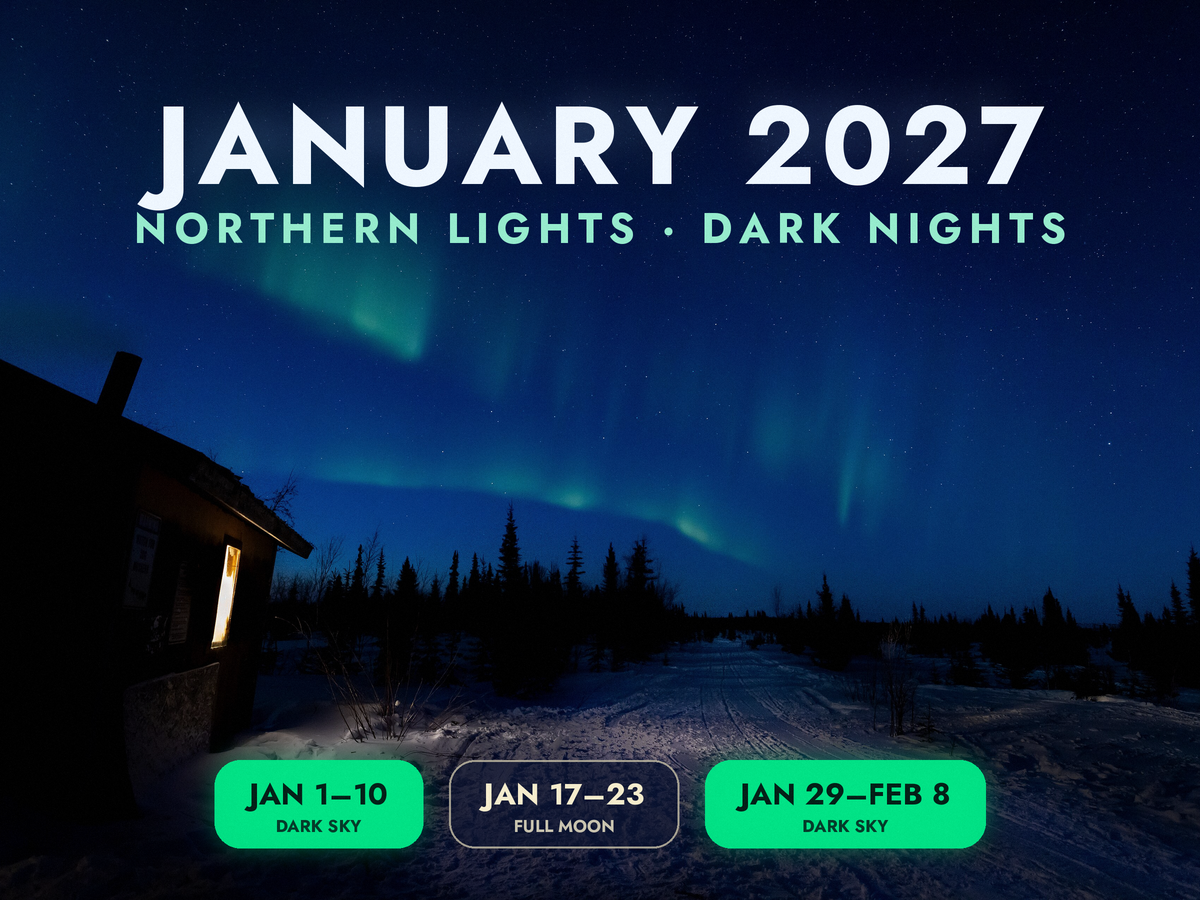
- December 4–13
- January 1–10
- January 29–February 8
- February 25–March 9
- March 25–29 is moonless too, but there are only about 2 hours of full darkness (2.1 hours on March 27), and Sky Station evenings end on March 27.
By month, that's 10 moonless nights in December, 13 in January, 12 in February and 14 in March (March's include the short late-March nights).
Nights with the moon up for nearly all the dark hours
- December 20–26
- January 17–23
- February 13–22
- March 12–23
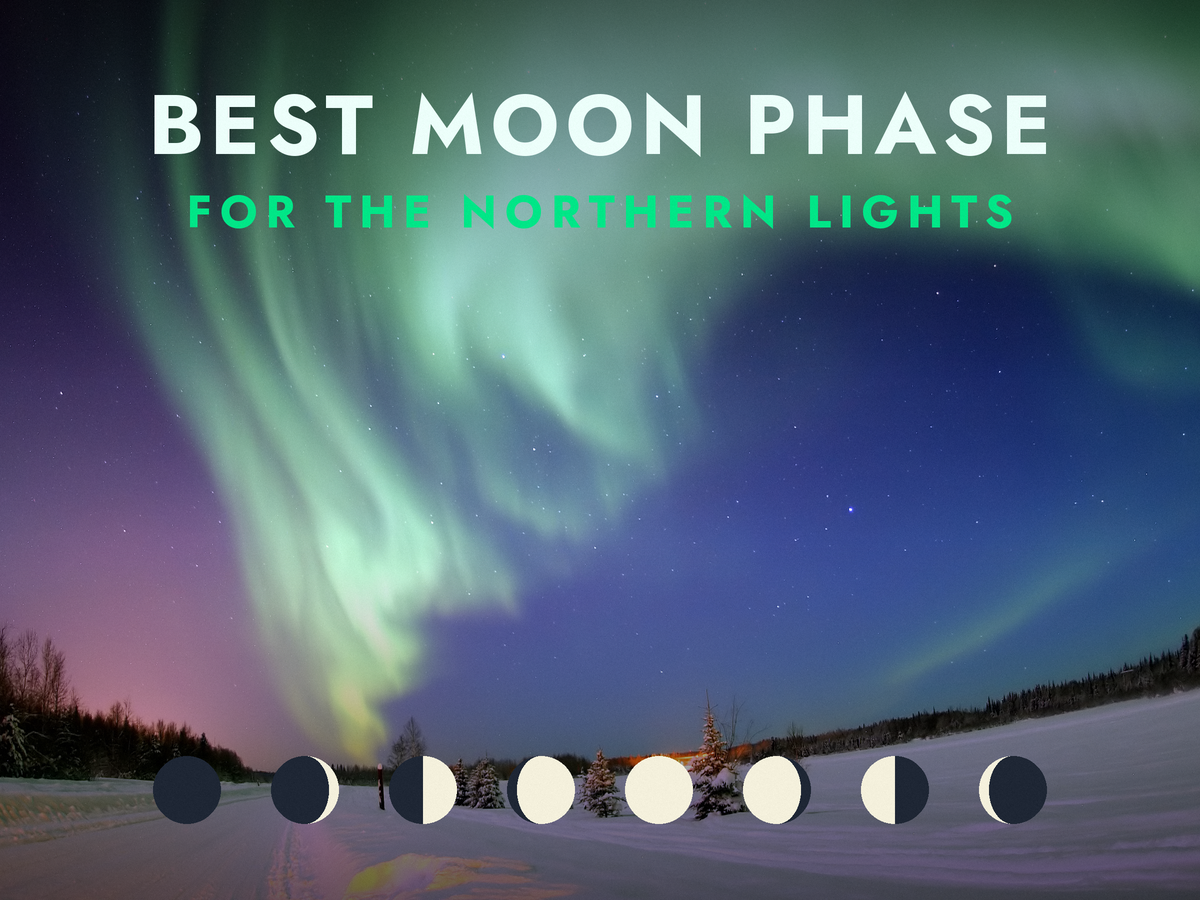
If those weeks are your only option, see the best moon phase to see the northern lights for how to work with moonlight.
How dark Abisko gets each month
Polar night in Abisko runs from December 6 to January 6. The last sunrise of 2026 is on December 5 (11:13 to 11:56 a.m.), and the first is on January 7, 2027 (sun up at 11:26 a.m., down at 12:15 p.m.). That's a flat-horizon calculation, so the surrounding mountains can delay the first visible sun by a few days. For more on how polar night shapes the season, see planning aurora viewing around polar day and polar night.
Hours of full darkness per night:
- December 1: 12.8 h
- December 15 and 21: 13.3 h
- January 15: 12.6 h
- February 15: 9.7 h
- March 1: 7.8 h
- March 15: 5.5 h
- March 27: 2.1 h
From the night of March 30 there is no full astronomical darkness at all.
Adding up each month, the moon-free dark hours (total dark hours in parentheses) are:
- December: about 227 h (410 h)
- January: about 228 h (385 h)
- February: about 151 h (271 h)
- March: about 86 h (150 h)
December and January give you the most dark sky. Late February to early March is still a good window, just with longer days. After mid-March the nights shorten quickly.
When in the night to be outside
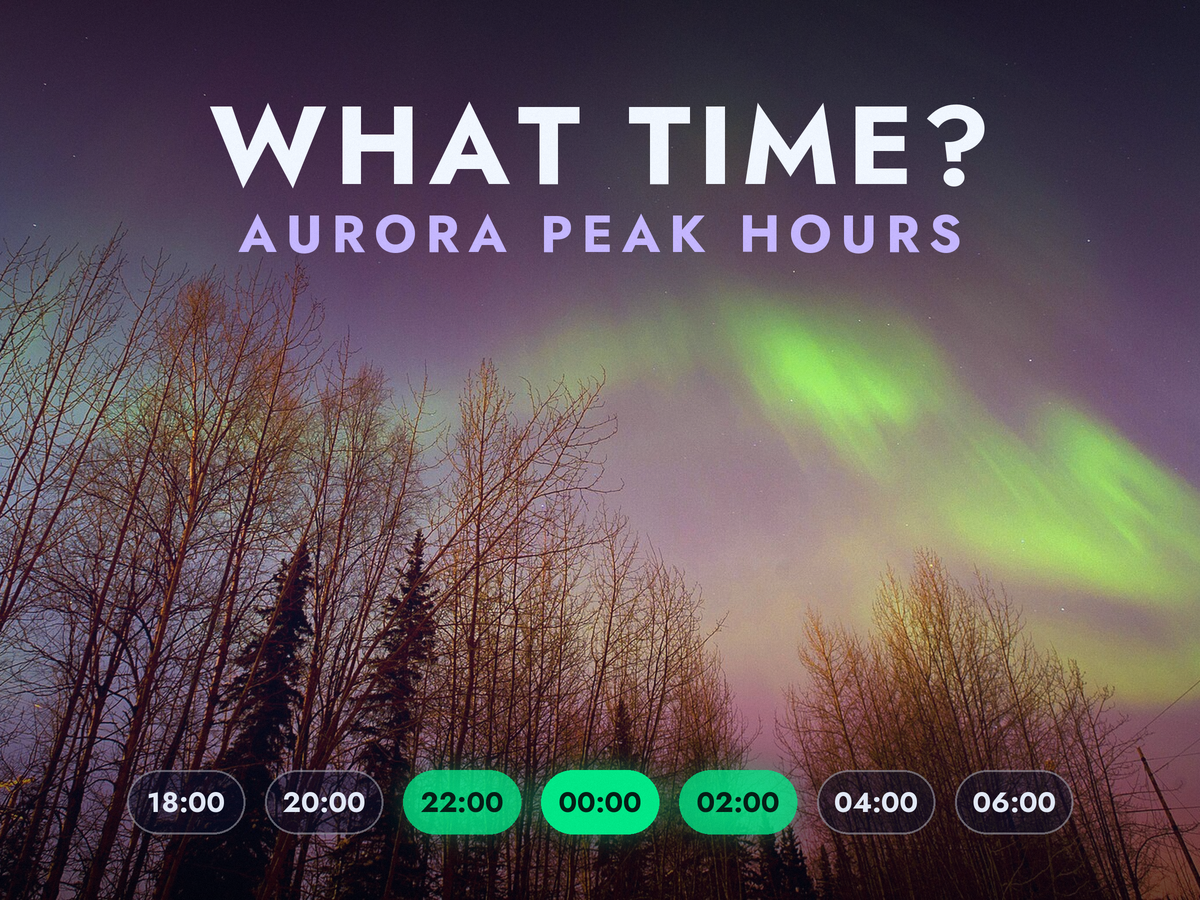
Magnetic midnight in Abisko is around 11:30 p.m. local time all winter. I calculated it with AACGM-v2 at 110 km: about 11:32 p.m. on December 15, 11:44 p.m. on January 15, 11:40 p.m. on February 15, and 11:28 p.m. on March 10. Abisko's magnetic latitude is about 65.9°.
Aurora is often most active around magnetic midnight, so plan to be outside from about 9 p.m. and stay past midnight. The Sky Station's evening hours (9 p.m. to 1 a.m.) cover exactly that window. Times for other places are in the best time of night to see the northern lights.
Aurora Sky Station: dates and what to know
The Sky Station is on Mt Njullá (Nuolja). According to the Swedish Tourist Association (STF), evening opening runs from October 19, 2026 to March 27, 2027, 9 p.m. to 1 a.m., and advance booking is required. Daytime opening is February 13 to April 26, 2027, 9:30 a.m. to 4 p.m.
- The chairlift's lower station is a 10-minute walk from STF Abisko Turiststation.
- The open two-seat chairs take 20 to 40 minutes to go up. You're in the wind the whole way, so dress warmly.
- The guided evening activity (Norrskensnatt, Night Visit) has only 40 places per night. Drop-in is possible only if places remain.
Opening dates can change, so check the official pages again before you book.
Picking the night once you're there
The moon fixes the dates, and the forecast picks the night. I start with the 3-day forecast, looking at hourly cloud cover and Kp. I want the hours where clouds drop and Kp rises to overlap. Before heading out, I check live solar wind and Kp.
Cold matters too. At the Abisko Scientific Research Station, the winter (December–February) mean temperature was −9.2°C for 2002–2011. Waiting outside in that kind of cold drains a phone battery fast, so keep your phone in an inside pocket. For phone-in-the-cold tips, see the best time to see the northern lights in January 2027.
In Aurora Eos you can set Abisko as a location and see hourly Kp, cloud cover and temperature in the 3-day forecast, plus live solar wind and Kp.
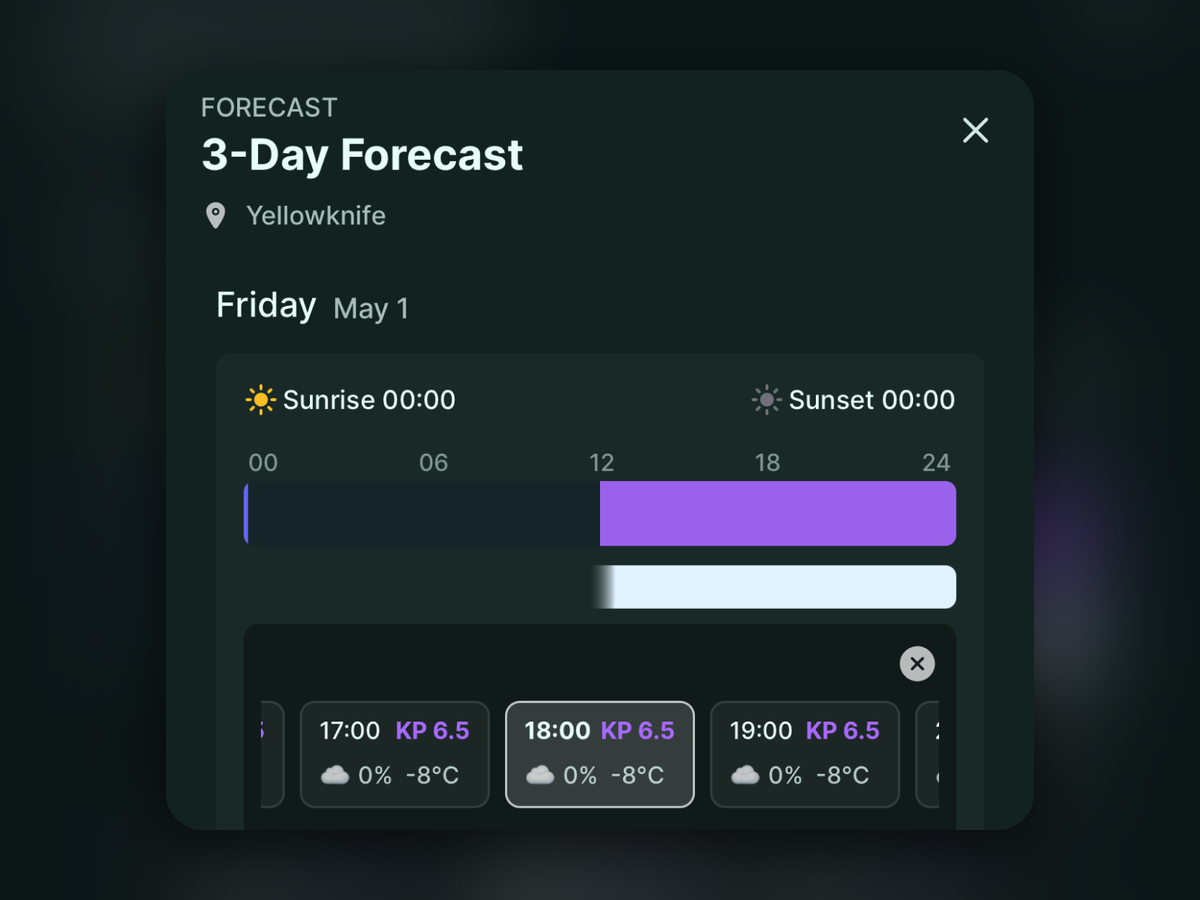
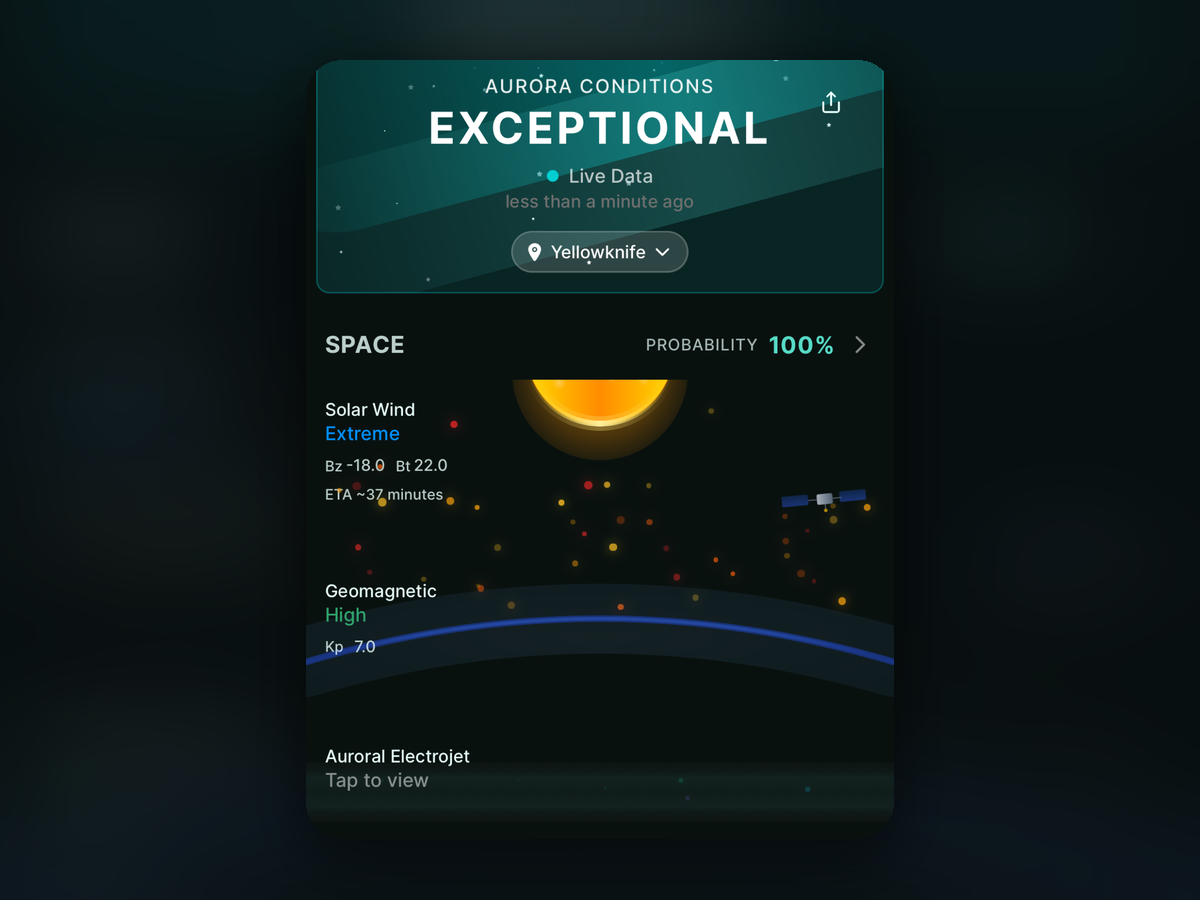
Big storms are sometimes forecast days ahead. Turning on geomagnetic storm forecast alerts makes them harder to miss.
Summary
- Moonless nights: December 4–13, January 1–10, January 29–February 8, February 25–March 9.
- Moon up nearly all night: December 20–26, January 17–23, February 13–22, March 12–23.
- Polar night runs December 6 to January 6. December and January have the most moon-free dark hours.
- Magnetic midnight is around 11:30 p.m. Be outside from about 9 p.m. until after midnight.
- Sky Station evenings run October 19, 2026 to March 27, 2027, 9 p.m. to 1 a.m., booking required.
For other months, see the best time to see the northern lights in November and December 2026 and in January 2027. If you haven't chosen a destination yet, start with how to choose a northern lights destination.
Sources
- SMHI — Centennial Stations: Abisko normal annual precipitation 347 mm (1991–2020), records since December 1912
- Callaghan et al. 2013, Phil. Trans. R. Soc. B 368: 20120488: Abisko Scientific Research Station winter mean temperature −9.2°C, 2002–2011
- STF — Abisko Turiststation opening hours: Sky Station evening and daytime dates
- STF — Aurora Sky Station guide: 10-minute walk to the lower station, 20–40 minute open chairlift ride
- Aurora Sky Station — Norrskensnatt: 40 places per night
- Moon phases, moonless nights, sunrise and sunset, and fully dark hours: my own calculations with the NASA JPL DE421 ephemeris (Python Skyfield, 5-minute steps, Abisko at 68.3495° N, 18.8312° E). Magnetic midnight: my own calculation with AACGM-v2 at 110 km
- Cover photo: Wikimedia Commons — Aurea borealis (Nordlichter) Abisko by Andrea Ullius, CC BY 2.0, cropped, color graded, text added
- Village photo: Wikimedia Commons — Northern Lights in Abisko by US Embassy Sweden, CC BY 2.0, resized, letterboxed
- Shoreline photo: Wikimedia Commons — Aurora-abisko-fisheye.jpg by Chad Blakley (lightsoverlapland.com), CC BY 3.0 DE, resized, letterboxed