The standard advice for picking aurora dates is "go around the new moon." It's good advice. But when I worked out where the moon actually sits in the sky this winter, I found that at high latitudes the phase alone can point you to the wrong nights.
Take Tromsø. On the night of January 29, 2027, the moon is a 45% half moon, and it never gets above the horizon. On the night of February 13, it's almost the same half moon at 46%, yet it doesn't set at all from dusk to morning. This post explains why that happens and lists the nights worth aiming for from December 2026 through March 2027.
The short answer: around the new moon, and whenever the moon is down
NOAA's Space Weather Prediction Center points out that a bright moon doesn't weaken the aurora itself. It lowers how bright the aurora looks. A strong display still shows up under a full moon, but the faint and moderate aurora you get on most nights is easily washed out.
So the week or so either side of a new moon is the default. What really matters, though, is whether the moon is below the horizon while it's dark. How full it is comes second. Everything below uses that test:
- Locations: Tromsø, Abisko, Rovaniemi, Reykjavik, Yellowknife, and Fairbanks
- Dark hours: the sun more than 18° below the horizon (after astronomical twilight ends)
- Dates: the night that starts on that evening
Moon phases, December 2026 to March 2027
New and full moon times, all in UTC:
- New moon Dec 9, 00:51 · Full moon Dec 24, 01:28
- New moon Jan 7, 2027, 20:24 · Full moon Jan 22, 12:17
- New moon Feb 6, 15:56 · Full moon Feb 20, 23:23
- New moon Mar 8, 09:29 · Full moon Mar 22, 10:43
The December 24 full moon is a supermoon, and the January 22, 2027 full moon is a supermoon too. I covered what the Christmas Eve full moon means for November and December trips in the best nights to see the northern lights in November and December 2026.
Moonless stretches at all six destinations
There are four stretches when the moon is below the horizon for at least 90% of the dark hours at every one of the six locations:
- December 4–12
- January 2–10, 2027 (from January 1 everywhere except Reykjavik)
- January 30 – February 8 (from January 29 in Tromsø, Abisko, Rovaniemi, and Fairbanks)
- February 26 – March 9 (from February 25 in Tromsø and Abisko)
And these are the nights when the moon is up for all of the dark hours, everywhere:
- December 20–25
- January 17–23
- February 14–21
- March 14–22
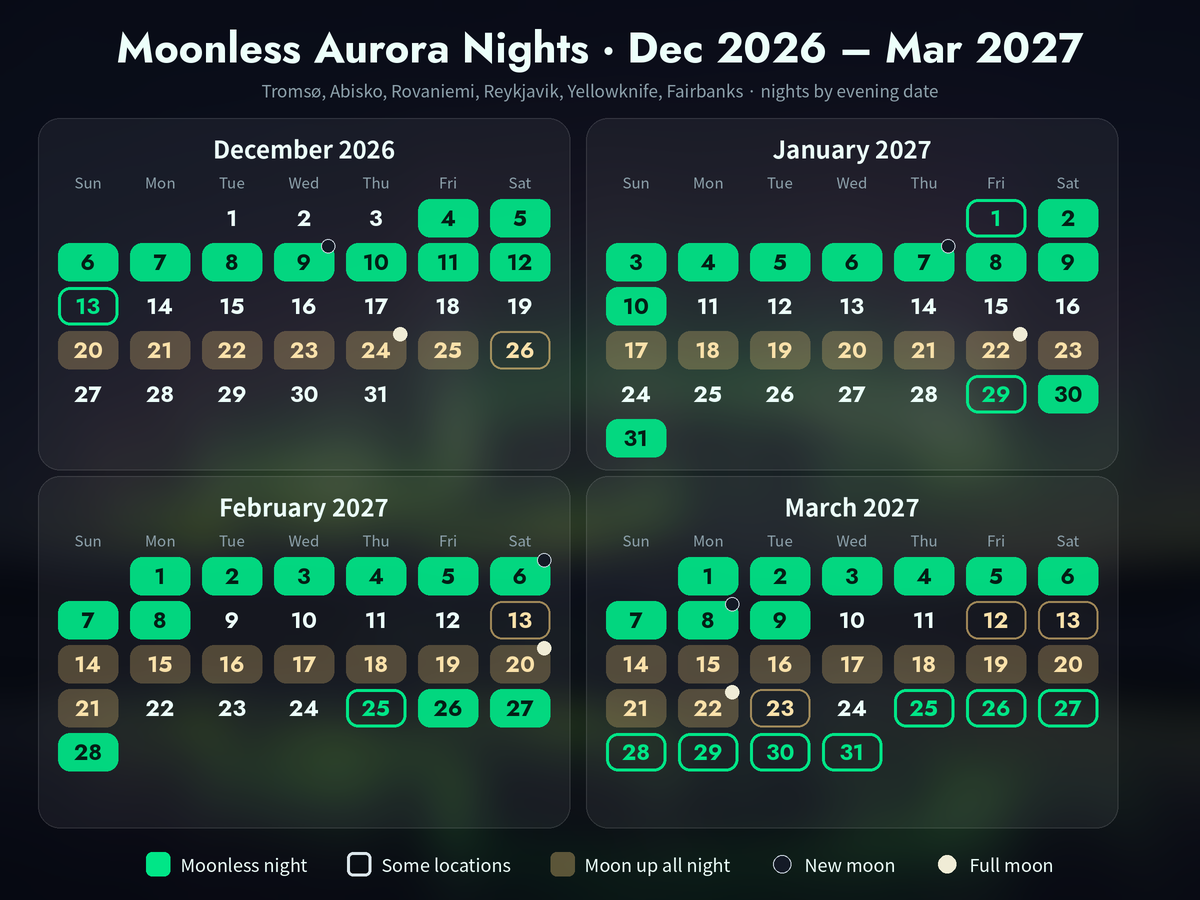
One thing stands out on the calendar. In December, the moonless stretch sits almost evenly around the new moon on the 9th. By February and March, it slides ahead of the new moon. In March, the new moon falls on the 8th, but the moonless run starts on February 26 and ends on March 9. The new moon ends up at the tail end of it.
Why the same half moon gives you such different nights
It comes down to the moon's path across the sky. Over a month, the moon follows roughly the same track the sun follows over a year. A full moon sits opposite the sun, which is why a midwinter full moon rides as high as the midsummer sun.
In late winter, the waxing half moon (first quarter) sits 90° east of the sun, where the late-spring and early-summer sun runs high. The waning half moon (last quarter) sits where the early-winter sun runs low. At high latitudes the difference is extreme. In Tromsø, at 69.65°N, the moon roughly stops setting once its declination climbs above +20.4°, and stops rising once it drops below −20.4°. This winter the moon's declination swings to about ±27.7°.
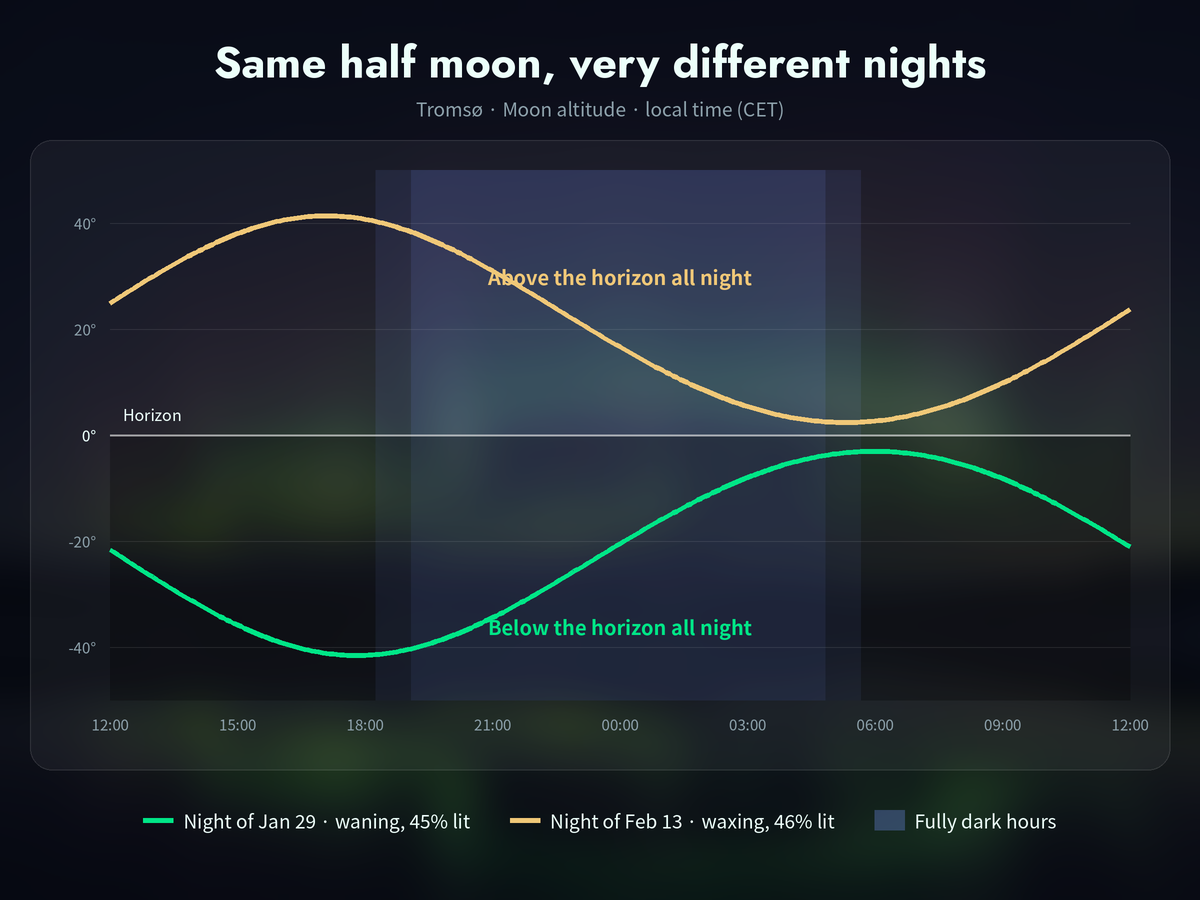
That leads to some surprising nights in Tromsø. On February 25, a 72% gibbous moon doesn't rise at all. On March 12, a thin 22% crescent stays up for the whole short night. If you picked mid-March because "it's only a crescent," the sky may be brighter than you expect.
December is different. Around the December 17 first quarter and the December 30 last quarter, the moon is close to the celestial equator, so the nights before and after the new moon look about the same. The effect also gets weaker the farther south you go, in Yellowknife or Reykjavik, for example. In February and March, though, it pushes the same way everywhere.
Christmas and New Year aurora trips
From December 20 to 25, the moon is up all night at all six places, so a trip over Christmas week can't avoid it. After the full moon, though, the moon rises later every night. Here are the moonrise times for Tromsø, in local time:
- December 27: 19:06
- December 28: 21:20
- December 29: 23:22
- Night of December 30: 01:23 on the 31st
- New Year's Eve: 03:32 on January 1
NOAA says the most active aurora usually shows up between 10 p.m. and 2 a.m. local time. From the night of December 30, most of that window is moon-free. On New Year's Eve the moon stays down until about 3:30 a.m., so if you get to ring in the new year under the aurora, the moon won't be the problem. On the same night the moon rises at 03:28 in Rovaniemi, 04:34 in Reykjavik, and 04:41 in Fairbanks.
The same pattern repeats after the January 22 full moon. In Tromsø, the moon rises at 20:39 on January 25 and 22:45 on January 26, then after midnight, at 00:54, on the night of January 27.
What to do on a bright, moonlit night
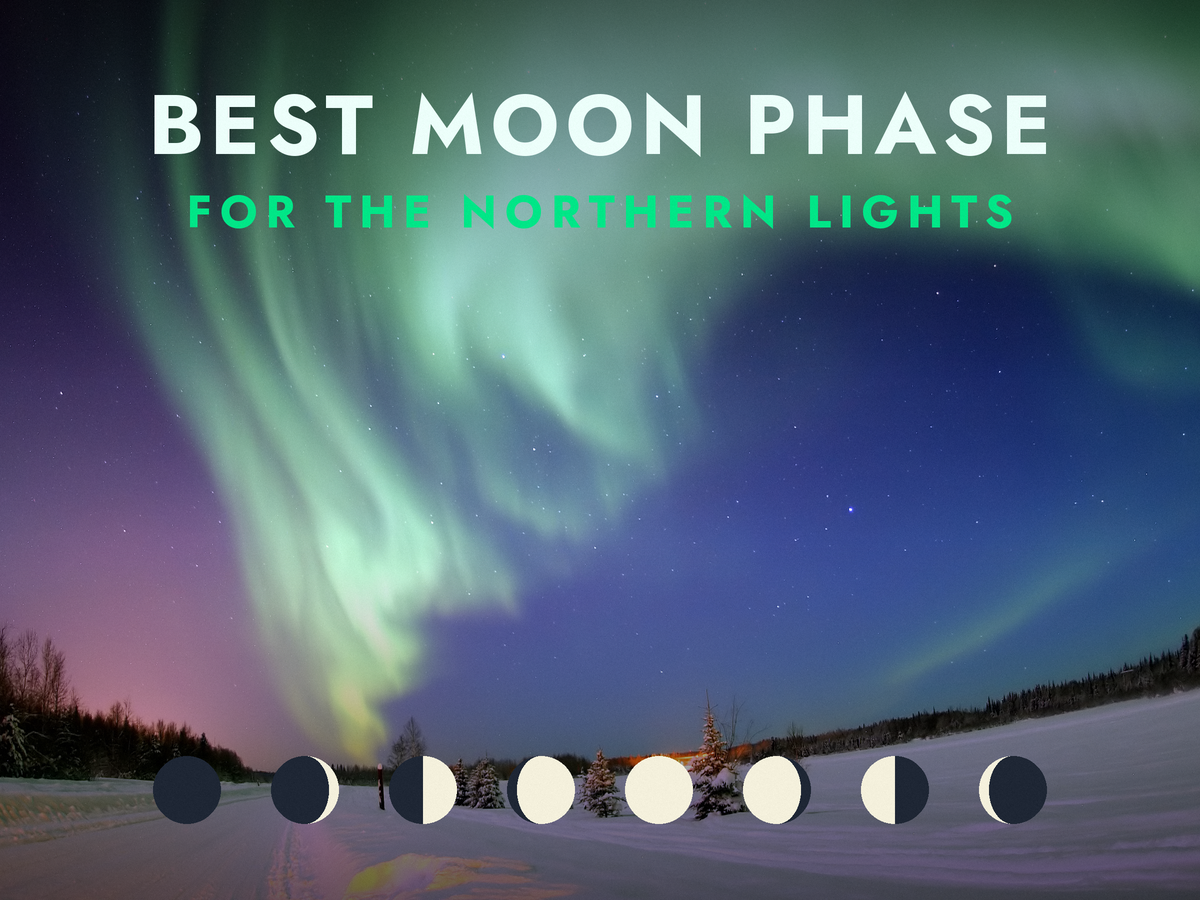
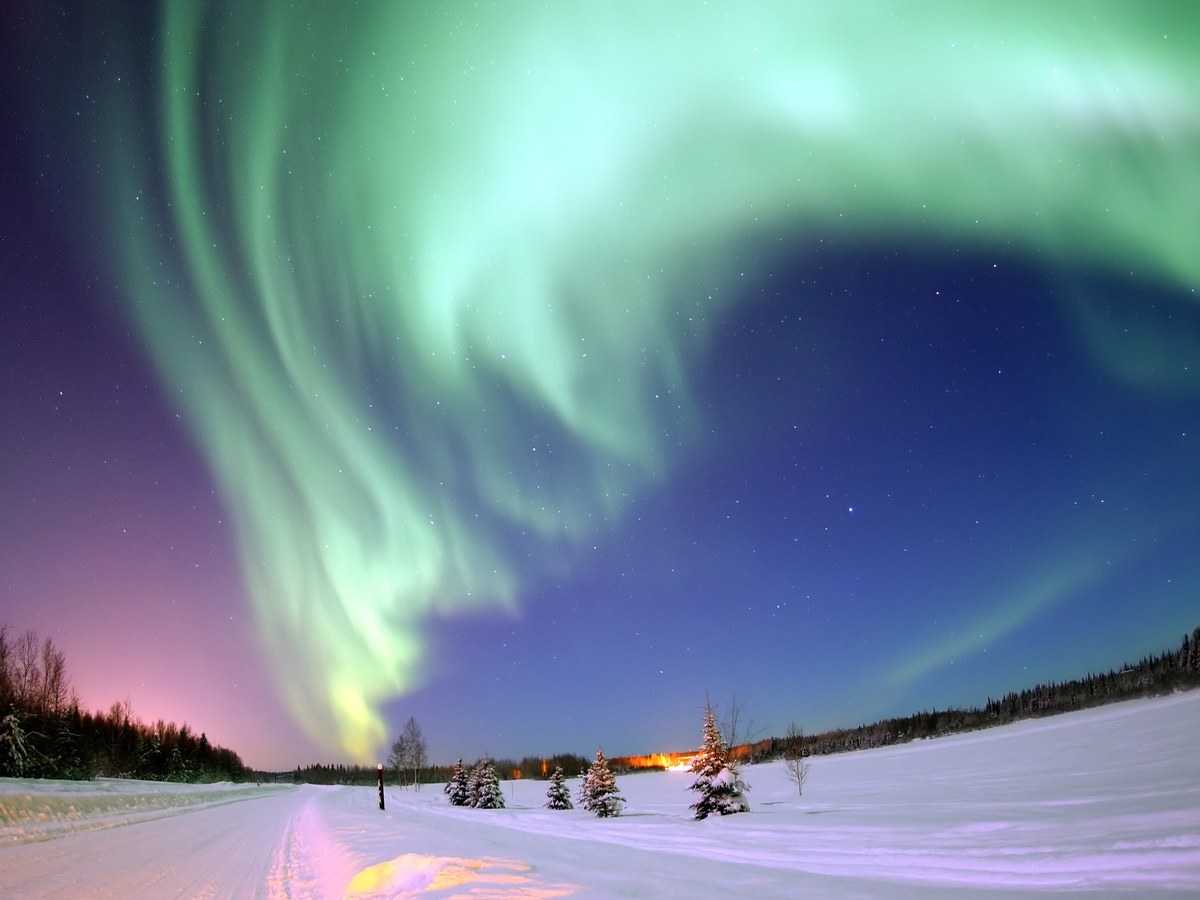
Moonlight isn't all bad. The photo below was taken over Bear Lake at Eielson Air Force Base in Alaska. Its recorded date, January 18, 2005, was the day after first quarter, with the moon about 60% lit. That's likely why the snow and trees show up so clearly.
- Keep the moon behind you and face north. Check when the moon is lowest that night.
- Get away from town lights. Moonlight plus light pollution flattens the contrast fast.
- Save your effort for nights with a higher geomagnetic forecast. A strong aurora beats the moon. Here's what Kp index you need to see the northern lights.
- If you're shooting, use the light. The moon brings out mountains and snow in the foreground. Go a little shorter on exposure. My settings for each phone are in how to photograph the northern lights with your phone.
Going in March? Watch the moon and the darkness together
March, around the equinox, is a good month for geomagnetic activity. I wrote about why in why auroras are more common around the equinox. The nights shrink quickly, though. In Tromsø, full darkness drops from about 7.6 hours on the night of March 1 to about 5 hours on March 15, and it's gone after the night of March 25. In Abisko it lasts until March 29.
That makes the February 26 – March 9 stretch especially valuable. When the nights are that short, a moon on top leaves almost nothing. For trips in late March or later, somewhere a bit farther south, such as Reykjavik or Yellowknife, works better. You can see how darkness changes through the seasons in planning aurora viewing around polar day and polar night.
How to check the moon on the night
Once your dates are set, the remaining question is when the moon rises and sets each night. I check that on the location screen in Aurora Eos. The Moon card in the EARTH section shows moonrise and moonset and whether the moon is currently above or below the horizon.
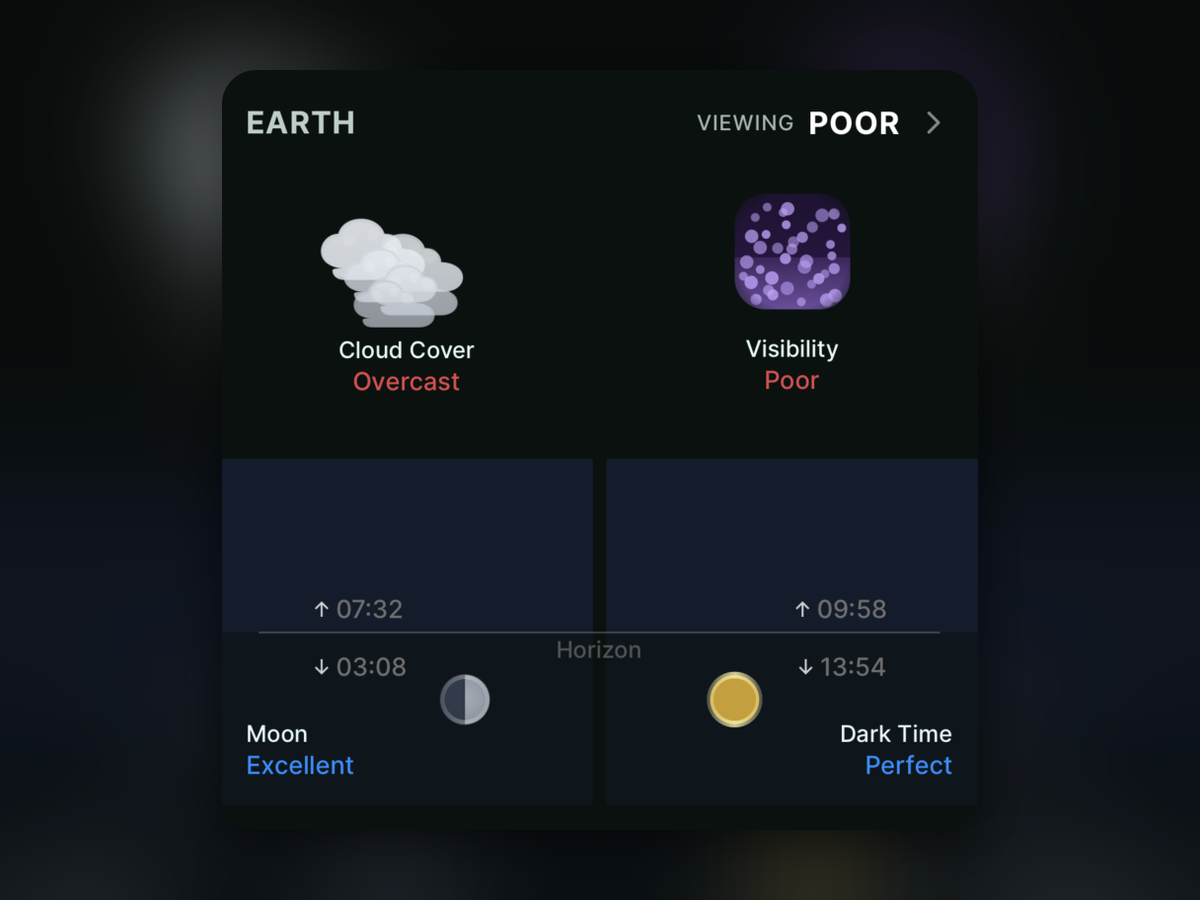
Here the half moon is below the horizon and the moon rating is Excellent. Whether it's up matters more than how full it is. Clouds still win, though: with overcast skies the overall viewing rating drops to Poor even when the moon and darkness are perfect.
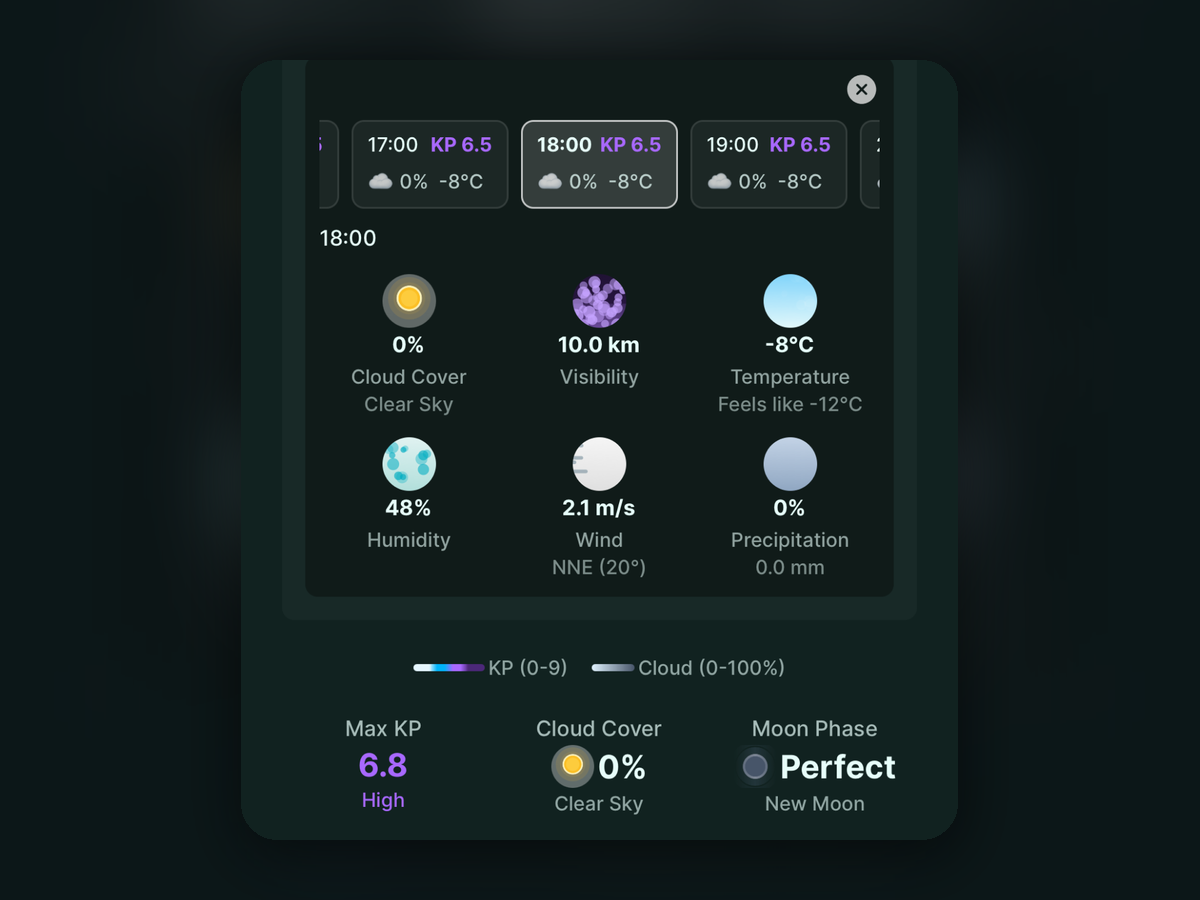
For the next few nights, I use the 3-day forecast. The moon phase sits next to the max Kp and cloud cover for each day, which makes it easy to decide which night is worth a long drive.
Summary
- The longest moonless stretches are December 4–12, January 2–10, January 30 – February 8, and February 26 – March 9.
- The moon is up all night on December 20–25, January 17–23, February 14–21, and March 14–22.
- In late winter at high latitudes, a waning half moon is far kinder than a waxing one. Check moonrise and moonset before the phase.
- After Christmas, the moon rises later each night, so the nights around New Year get darker and darker.
The moon is about the only thing you can check months ahead. Clouds and solar wind only show their hand a few days out. Narrow your dates with the moon, then pick your nights with the forecast.
Sources
- NOAA SWPC — Tips on Viewing the Aurora: how moonlight affects viewing, and the 10 p.m. to 2 a.m. window
- timeanddate — Moon Phases 2026 (UTC), Moon Phases 2027 (UTC): new and full moon times, supermoons
- Moon altitude, moonrise and moonset, and dark hours: my own calculations with the NASA JPL DE421 ephemeris (Python Skyfield, 5-minute steps)
- Wikimedia Commons — Aurora borealis over Eielson Air Force Base, Alaska: photo by Senior Airman Joshua Strang, U.S. Air Force, public domain