I've written "between 10 p.m. and 2 a.m." in more than one aurora post. It's NOAA's rule of thumb, and most aurora guides repeat it. But when I worked out the timing for each destination, the middle of that four-hour window moved around more than I expected.
On the night of December 15, 2026, the peak is centered around 11:30 p.m. in Tromsø and after 2 a.m. in Yellowknife. Stick to "10 to 2" in Yellowknife and you could be back at your hotel before half of the best hours have even started. This post explains why the timing shifts and what time to watch the sky at each destination this winter.
The short answer: magnetic midnight, not clock midnight
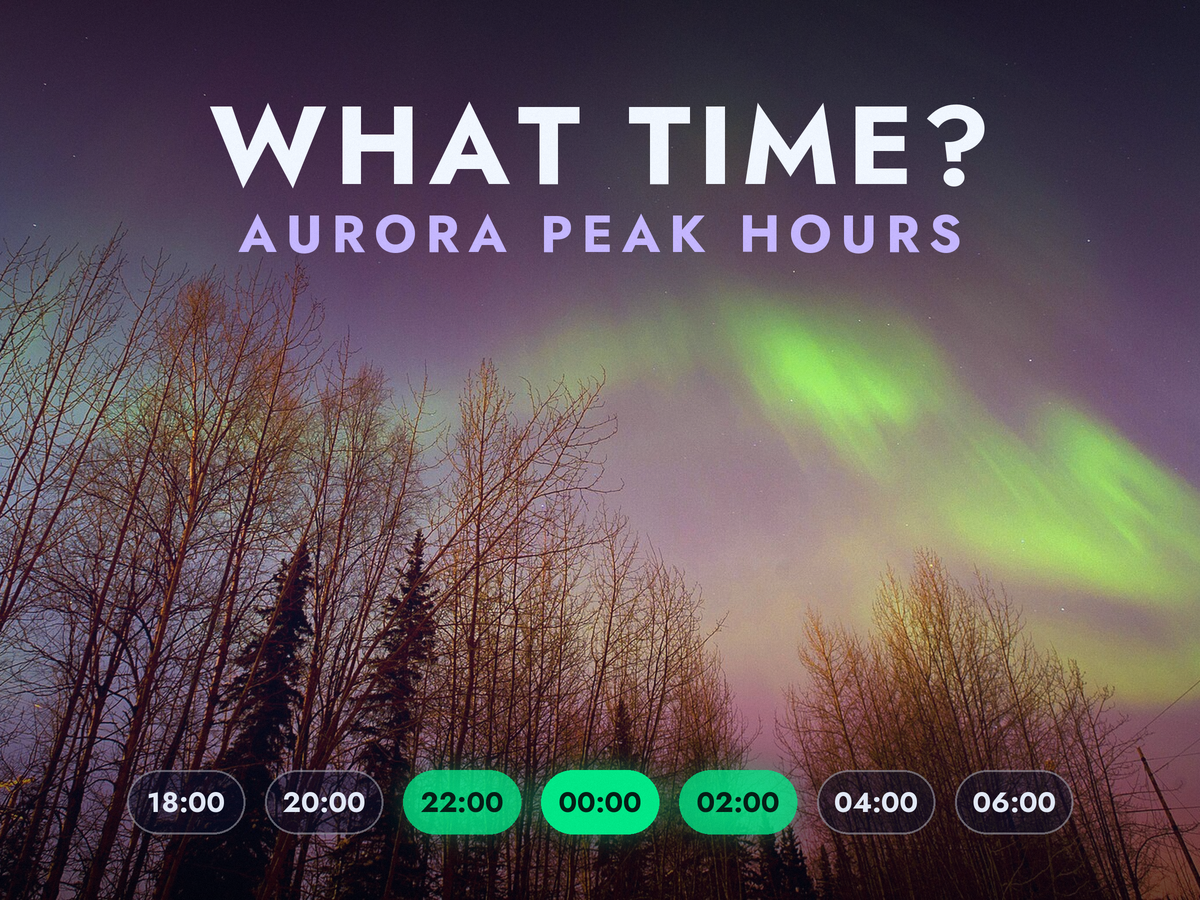
NOAA's Space Weather Prediction Center (SWPC) says the best aurora is usually within an hour or two of midnight, between 10 p.m. and 2 a.m. local time, and that this window stretches toward evening and morning as geomagnetic activity rises.
The midnight that matters is magnetic midnight. The auroral oval is a ring around the geomagnetic pole, and it is most active on the night side, directly opposite the Sun. As Earth turns underneath it, magnetic midnight is the moment your location lines up opposite the Sun in Earth's magnetic frame. The northern end of the geomagnetic axis sits between the Canadian Arctic islands and Greenland, and time zones follow borders rather than physics, so magnetic midnight can land an hour or two away from the clock.
Substorms, the bursts that suddenly light up the sky, cluster around the same time. A 2016 paper working with Tromsø magnetometer data notes that substorms happen on most nights, normally within three hours of magnetic midnight.
Magnetic midnight by destination
I calculated magnetic midnight with AACGM-v2, a coordinate model widely used in aurora research, at 110 km, the height where the aurora glows. These are local times for the night of December 15, 2026.
- Tromsø 11:28 p.m.
- Abisko 11:32 p.m.
- Rovaniemi 12:12 a.m.
- Reykjavik 12:52 a.m.
- Fairbanks 1:38 a.m.
- Yellowknife 2:06 a.m.
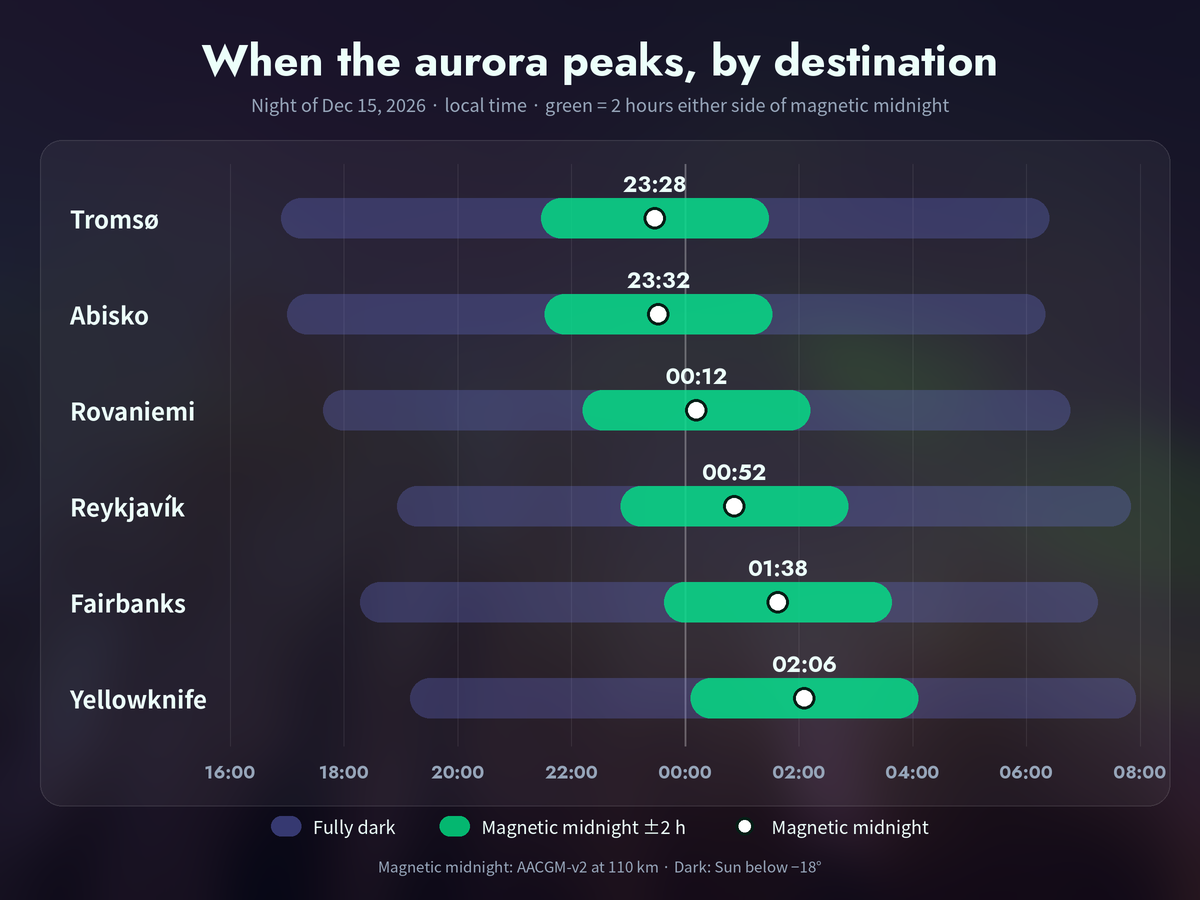
Look at how the green window sits inside the dark hours. In December, Tromsø is fully dark before 5 p.m., which leaves more than four hours before the active window even begins. Yellowknife doesn't get fully dark until about 7 p.m., but its green window runs until 4 a.m.
Different models give slightly different times. With a simple dipole model, which treats Earth's field like a bar magnet, Tromsø comes out at 10:22 p.m., about an hour earlier. Reykjavik comes out at 12:26 a.m., Fairbanks at 1:52 a.m., and Yellowknife at 2:20 a.m. The gap is largest in Scandinavia, so it's better to think in ranges, such as 10:30–11:30 p.m. for Tromsø and Abisko and around 2 a.m. for Yellowknife, than in exact minutes.
It drifts later through the winter
Magnetic midnight also shifts a little with the seasons. Running the same model for the 15th of each month puts Tromsø at 11:12 p.m. in November, 11:28 p.m. in December, 11:40 p.m. in January, and 11:36 p.m. in February. Yellowknife moves from 2:02 a.m. in November to 2:36 a.m. in February. In midwinter, plan on about 30 minutes later than in November.
For a March trip, check daylight saving time. In 2027, the US and Canada spring forward on March 14 and Europe on March 28. The sky doesn't change, but the clock reads an hour later, so add an hour to the times above after those dates.
How a typical aurora night unfolds
NOAA describes three stages for a night of moderate activity, around Kp 4 to 7. Knowing which stage you're in makes it easier to decide whether to keep waiting.
- Evening: After sunset you may see a single arc stretching east to west, or a few parallel arcs. They can hang there for a long time without moving much. At first glance they can look like thin cloud.
- Around midnight: The arcs start to ripple and fold like a curtain. When a substorm hits, the aurora brightens suddenly, spreads quickly toward the south, and fills the sky with swirls and bright rays. This is the dancing aurora most people come for.
- Toward morning: An hour or two past midnight the aurora breaks up into diffuse, patchy glow. The patches often pulse on and off about every 10 seconds and can last until dawn. They look flat to the eye, but a time-lapse shows the pulsing.
One substorm isn't always the end of the night. Syun-Ichi Akasofu, who first described the auroral substorm, observed as many as four in a single night, and a full cycle from quiet curtain to breakup can play out in as little as one to three hours. If the sky goes quiet after a big burst, that's not necessarily the signal to pack up.
Big storms are different. According to NOAA, at Kp 8 or 9 the active aurora is no longer limited to the hours around midnight. It spreads into the evening and morning, and bright aurora can last nearly all night.
So what time should you go out?
A simple rule works well: be at your viewing spot two hours before magnetic midnight, and stay until two hours after. For this winter, that comes out to:
- Tromsø and Abisko: in place by 9:30 p.m., stay until about 1:30 a.m. It gets dark so early that you'll have plenty of time for the evening arcs too. If the aurora is already showing in the evening, the hours around midnight are worth waiting for.
- Rovaniemi: roughly 10 p.m. to 2 a.m.
- Reykjavik: roughly 11 p.m. to 3 a.m. It's in Europe too, but the peak comes more than an hour later than in Tromsø.
- Fairbanks and Yellowknife: from about midnight to 3 or 4 a.m. The University of Alaska Fairbanks Geophysical Institute also points to 9 p.m. to 3 a.m. as the higher-probability window for interior Alaska in winter.
These are the most likely hours, not the only ones. The aurora shows up in the evening and toward morning too, so if the sky is clear once it gets dark, a quick early look costs you nothing. The first time I saw the aurora, in Ottawa, I'd been watching for about an hour before I could make out a faint curtain. Your eyes need time to adjust to the dark as well.
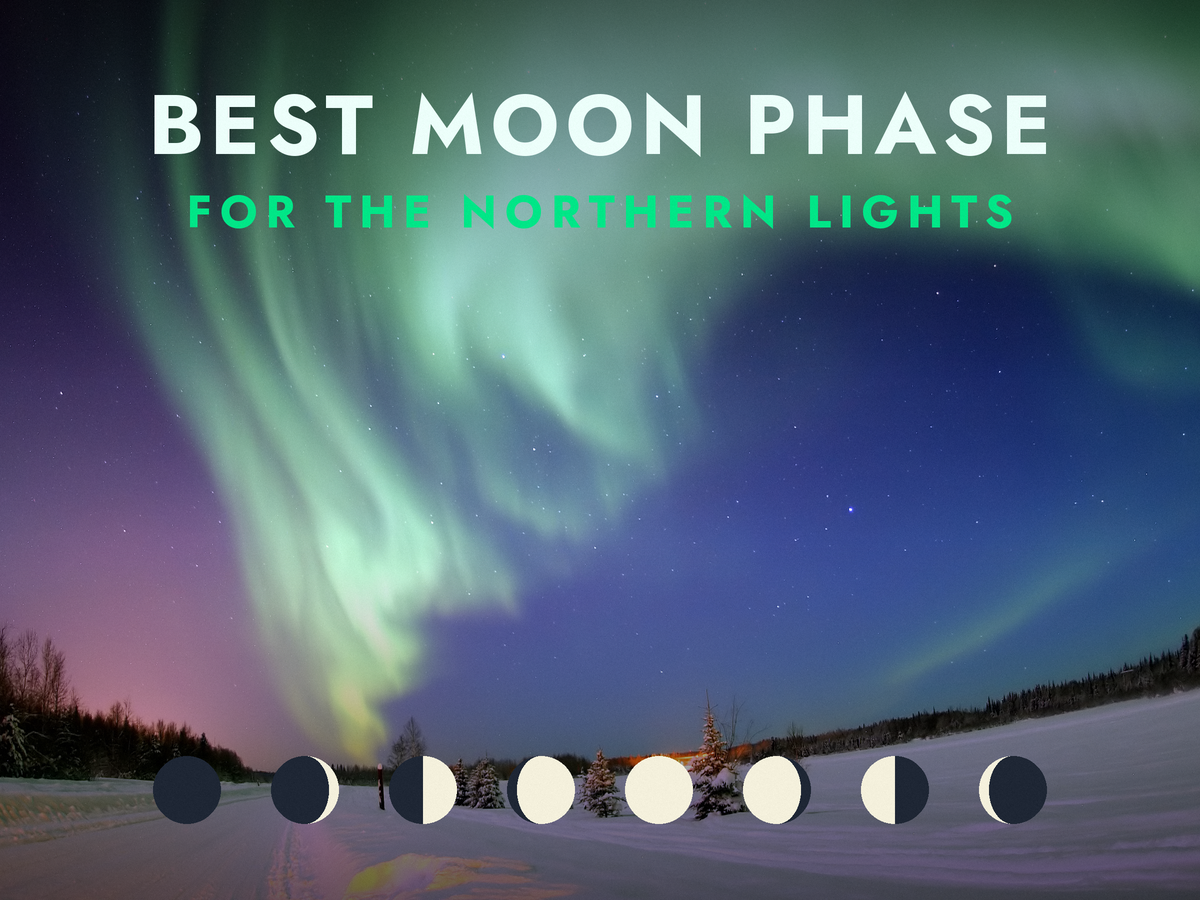
Check the moon too. If it sets before magnetic midnight, or rises after it, you get the best hours under a dark sky. I listed moonrise times by date in Best Moon Phase to See the Northern Lights.
Finding your hours in the 3-hour forecast
NOAA's 3-day forecast splits each day into 3-hour blocks in UTC and gives a Kp forecast for each. Convert magnetic midnight to UTC and you know which block to watch for each destination.
- Tromsø, Abisko, Rovaniemi: the 21–00 UT block (magnetic midnight falls around 22:00 UTC)
- Reykjavik: the 00–03 UT block (00:52 UTC)
- Fairbanks and Yellowknife: the 09–12 UT block (10:38 and 09:06 UTC)
A Kp 6 in the 15–18 UT block falls in the middle of the day in Yellowknife. On the other hand, a Kp of 4 in your own block can be plenty if you're right under the oval. I covered how to read Kp by destination in What Kp Index Do You Need to See the Northern Lights?
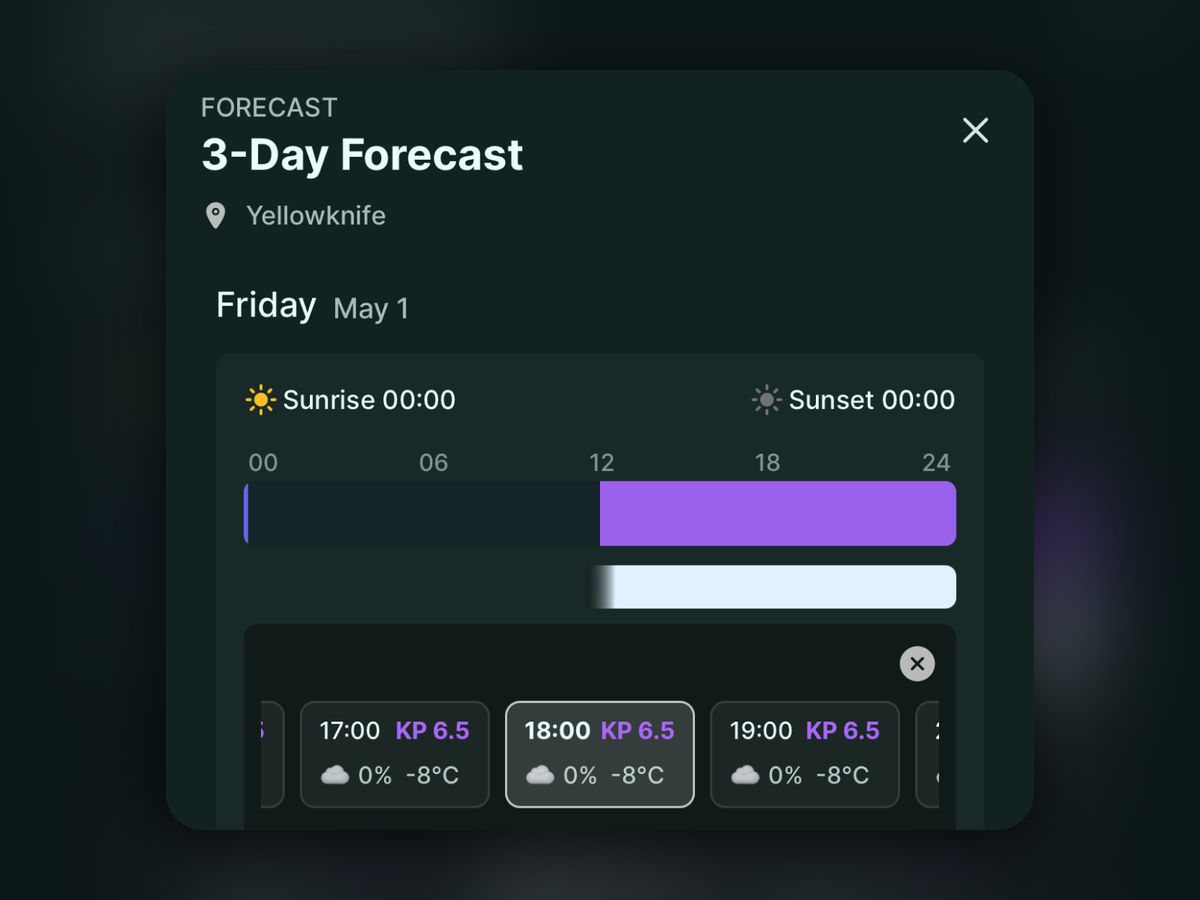
Aurora Eos's 3-day forecast does that conversion for you. Set your viewing spot to Yellowknife and the hourly Kp and cloud cover appear in Yellowknife time, so you only need to look at the hours around magnetic midnight.
On the night, watch the solar wind
The 3-hour forecast only gives you the broad picture. To get a feel for when a substorm might hit, you need the solar wind that night. A satellite at the L1 point, 1.5 million km from Earth, measures it first, so there's a little lead time before it arrives.
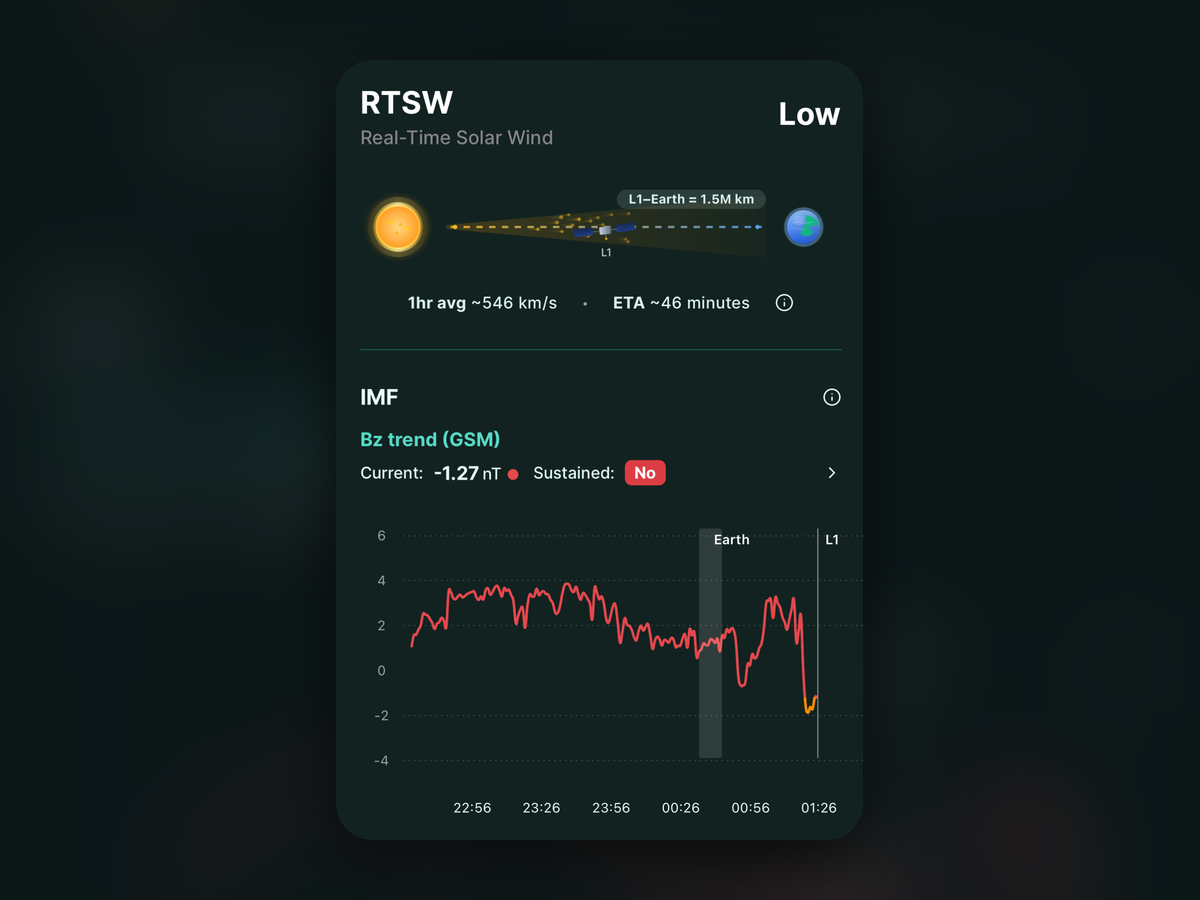
The number to watch is Bz. When Bz turns south (negative) and stays there, the odds of a substorm go up. If it has just dipped negative but isn't sustained yet, as in the screen above, the next 40–50 minutes, while that solar wind reaches Earth, are worth waiting out. If that lines up with magnetic midnight, you have every reason to be outside. There's more on reading Bz and the solar wind in How to Interpret Aurora Conditions.
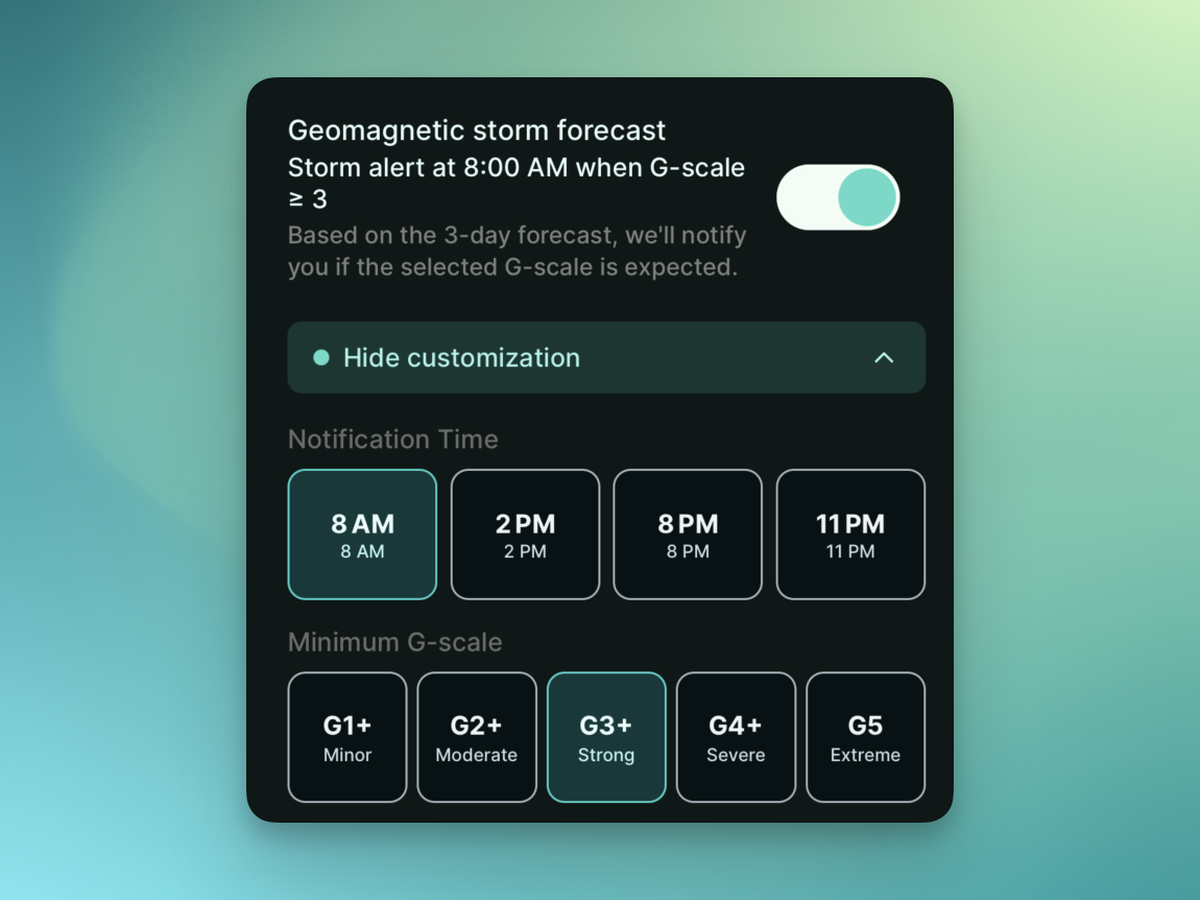
On a trip, I'd set the geomagnetic storm forecast alert to 8 PM. That's three to four hours before magnetic midnight, which leaves time to layer up and get to your spot. The alert settings are covered in Get Geomagnetic Storm Forecast Alerts.
Summary
- The aurora is most active around magnetic midnight. Substorms usually happen within three hours of it.
- In mid-December 2026, magnetic midnight is around 11:30 p.m. in Tromsø and Abisko, around midnight in Rovaniemi, around 1 a.m. in Reykjavik, around 1:30 a.m. in Fairbanks, and around 2 a.m. in Yellowknife.
- In Scandinavia, the key hours start around 10 p.m. In Alaska and Canada, they run from midnight to 3 or 4 a.m.
- Don't leave right after the first burst. Several substorms can happen in one night.
Pick your dates by the moon, pick your nights by the forecast, and decide how late to stay by magnetic midnight. If you haven't settled on dates yet, see Best Time to See the Northern Lights in November and December 2026 and How to Choose a Northern Lights Destination.
Sources
- NOAA SWPC — Tips on Viewing the Aurora: the 10 p.m. to 2 a.m. window and how it widens with activity
- NOAA SWPC — Aurora Tutorial: evening, midnight, and morning aurora, and all-night aurora at Kp 8–9
- Journal of Space Weather and Space Climate (2016): substorms on most nights, normally within ±3 hours of magnetic midnight
- UAF Geophysical Institute — The Auroral Substorm: Akasofu's substorm cycle and up to four substorms in a night
- UAF Geophysical Institute — Aurora Forecast: 9 p.m. to 3 a.m. in interior Alaska in winter
- Magnetic midnight: my own calculation with AACGM-v2 at 110 km; the dipole comparison uses IGRF 2025 coefficients. Dark hours: my own calculation with the NASA JPL DE421 ephemeris (Python Skyfield)
- Cover photo: Wikimedia Commons — Alaska Aurora Borealis, by Justin Connaher, released by the U.S. Air Force (Joint Base Elmendorf-Richardson, Alaska, March 2012), public domain, cropped and color graded