The first number you see in almost any aurora app is the Kp index. And the questions I hear most from people planning an aurora trip are about that number: "Is Kp 3 enough?" "The forecast says Kp 2. Should I just stay in tonight?"
The honest answer is that it depends on where you are. In Tromsø or Yellowknife, Kp 1 or 2 is often plenty. In Ottawa, Canada, where I first waited for the northern lights, you need something like Kp 7 before the aurora can reach overhead. This guide explains what Kp actually measures and which Kp to watch for at popular aurora destinations and cities.
Kp tells you how far south the aurora can reach
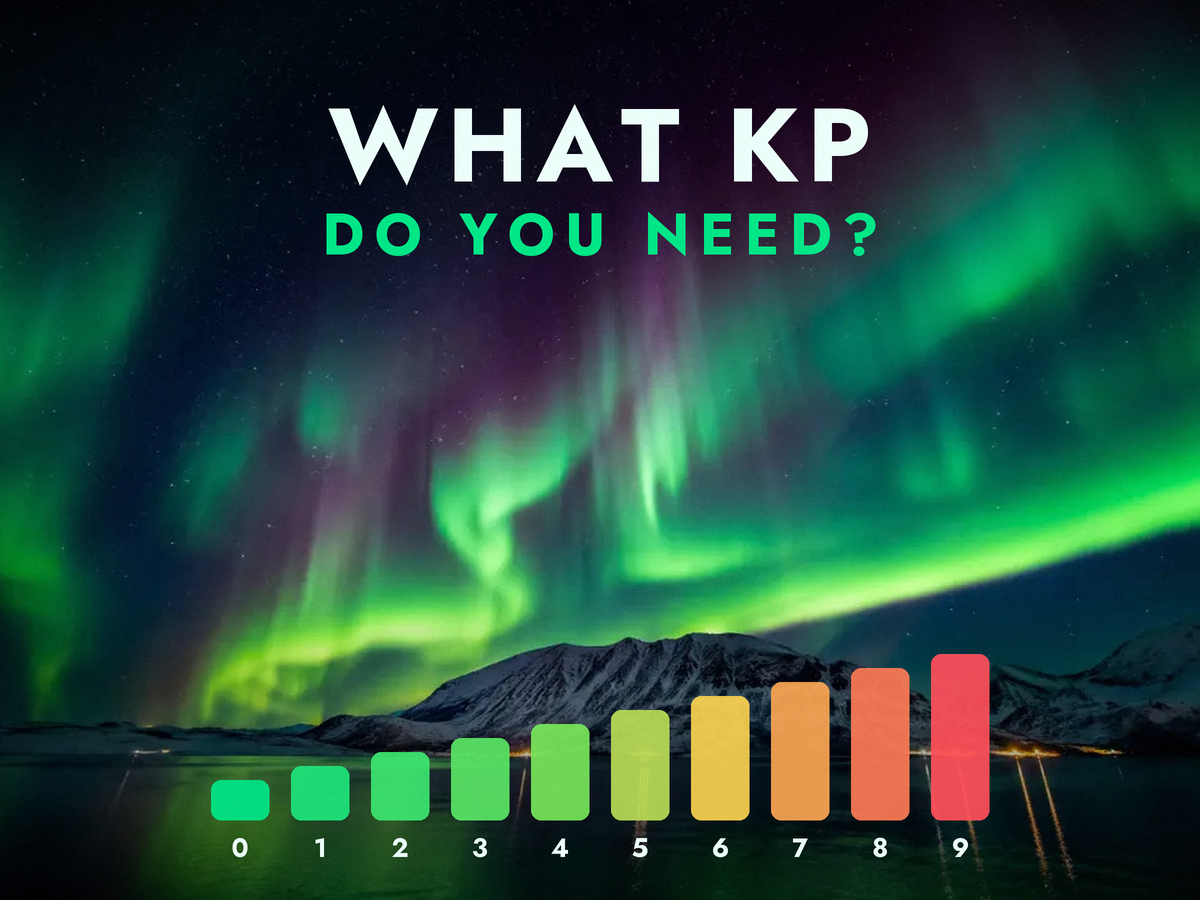
Kp is a 0–9 scale of how disturbed Earth's magnetic field is. According to NOAA, it's calculated every three hours from 13 magnetic observatories between 44° and 60° geomagnetic latitude, and a value of 5 or higher counts as a geomagnetic storm.
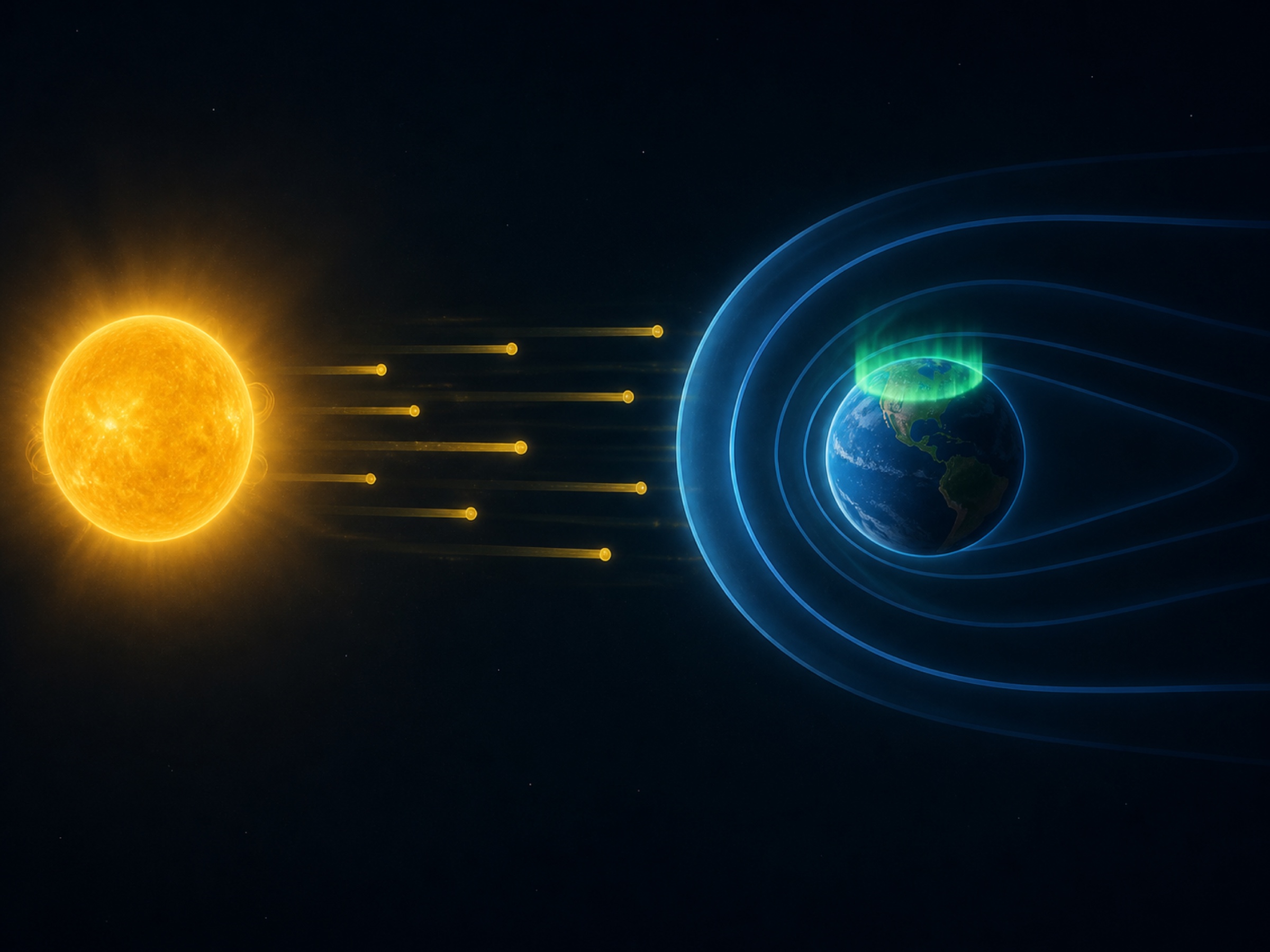
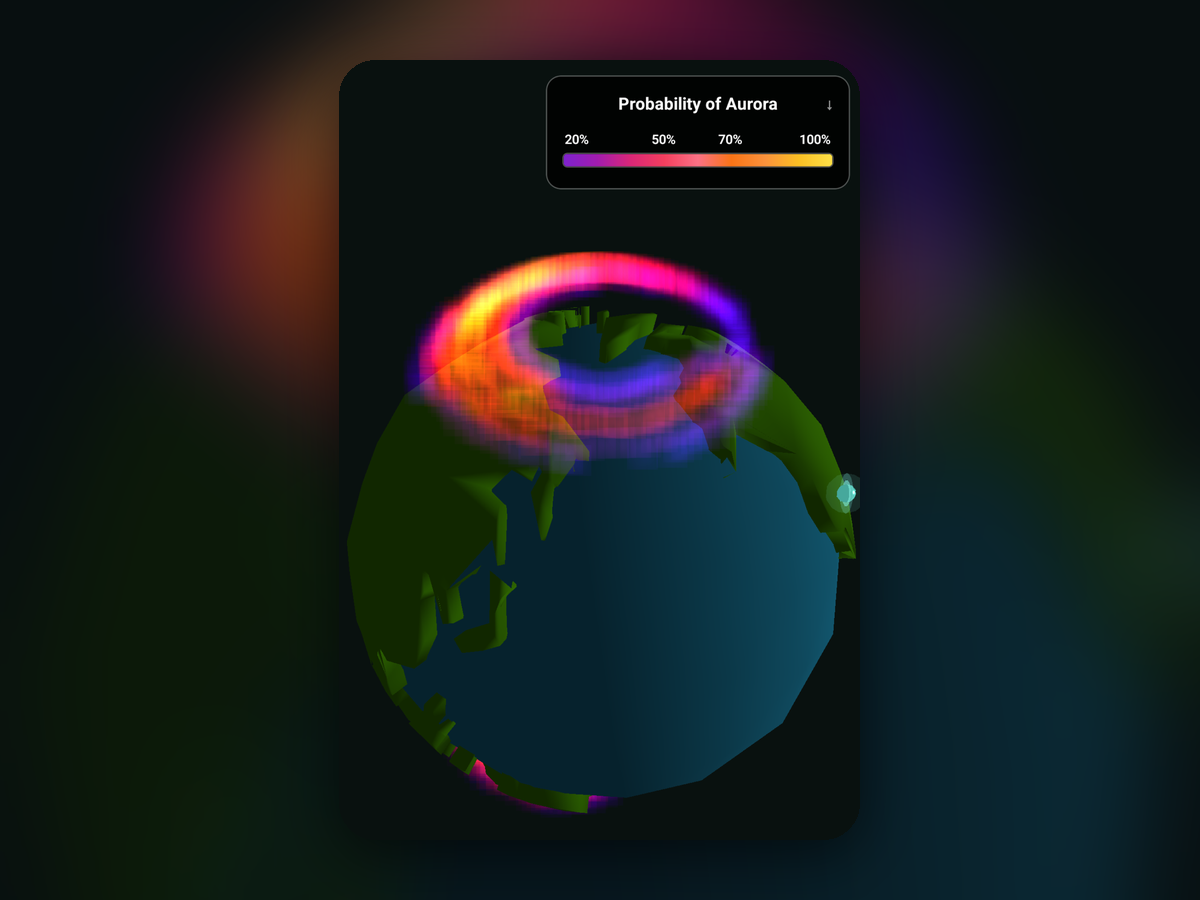
For aurora hunters, what matters is that Kp maps to the position of the auroral oval. The aurora forms a ring around each magnetic pole, and as geomagnetic activity picks up, that ring widens toward the equator. NOAA describes the oval's equatorward edge as sitting near 66° magnetic latitude at Kp 0 and moving about 2° closer to the equator with each step, reaching around 48° at Kp 9.
So Kp isn't really "the chance of seeing aurora tonight." It's closer to "how far south the aurora can come tonight." If you're already under the oval, a low Kp is fine. If you're far from it, you need a high one.
Use magnetic latitude, not the latitude on a map
This is where most Kp charts get confusing. The latitudes in a Kp chart are magnetic latitudes, not the ones on a map. Earth's magnetic north pole is offset toward northern Canada, so at the same map latitude, North America sits at a higher magnetic latitude than Europe or Asia.
When I ran the numbers, the difference was bigger than I expected. Yellowknife is at 62.5°N, more than 7° south of Tromsø (69.6°N), yet its magnetic latitude is 68.5°, higher than Tromsø's 67.3°. Seoul, at 37.6°N, drops to just 32.6° magnetic. That's part of why northern Canada is such a reliable place to see the aurora.
What Kp you need, city by city
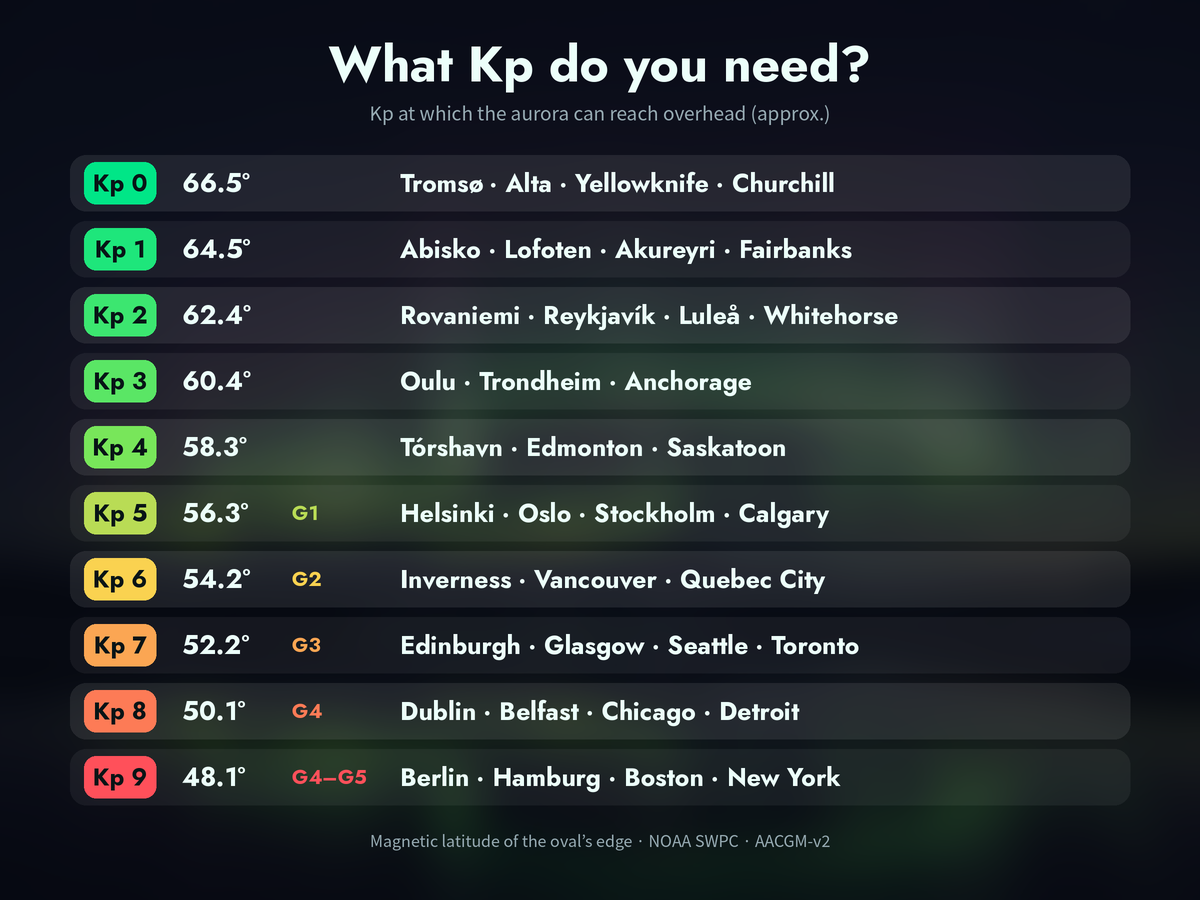
I calculated the magnetic latitude of major aurora destinations and cities and matched them to NOAA's Kp-to-oval relationship. I used the AACGM-v2 model, which is widely used in aurora research, for November 2026 at 110 km, the height where the aurora glows. The Kp values below are a rough guide to when the aurora can reach overhead.
Kp 0–2: right under the auroral oval
- Kp 0: Tromsø, Alta, Yellowknife, Churchill
- Kp 1: Abisko, Lofoten, Akureyri, Fairbanks
- Kp 2: Rovaniemi, Reykjavík, Luleå, Whitehorse
Most classic aurora destinations land here. At these places, clouds, darkness, and the moon matter far more than the Kp number. NOAA notes that if you're in the right place under the aurora, you can see very nice displays even at Kp 3 or 4. A forecast of Kp 2 is not a reason to cancel your night.
Kp 3–5: Nordic cities and the Canadian Prairies
- Kp 3: Oulu, Trondheim, Anchorage
- Kp 4: Tórshavn (Faroe Islands), Edmonton, Saskatoon
- Kp 5 (G1): Helsinki, Oslo, Stockholm, Calgary
If you're staying in a Nordic capital, watching for a G1 storm forecast is the realistic plan. Get away from city lights and find a spot with an open view to the north.
Kp 6 and up: you need a real storm
- Kp 6 (G2): Inverness, Vancouver, Quebec City
- Kp 7 (G3): Edinburgh, Glasgow, Seattle, Toronto
- Kp 8 (G4): Dublin, Belfast, Chicago, Detroit
- Kp 9 (G4–G5): Berlin, Hamburg, Boston, New York
At these latitudes you need a major geomagnetic storm. It does happen, though. On November 12, 2025 (UTC), a G4 storm brought the aurora as far south as Florida and Alabama.
Why people still see it south of these lines
The chart shows when the aurora can be overhead. Because the aurora glows more than 100 km above the ground, you can see it above the northern horizon even when the oval is well to your north. NOAA says that from a hilltop with a clear view north, you can see aurora up to about 1,000 km away. So if your city is one step short on the chart, a dark spot with an open northern horizon can still give you a chance, and a camera picks up faint aurora better than your eyes.
How to read Kp values like 4.67
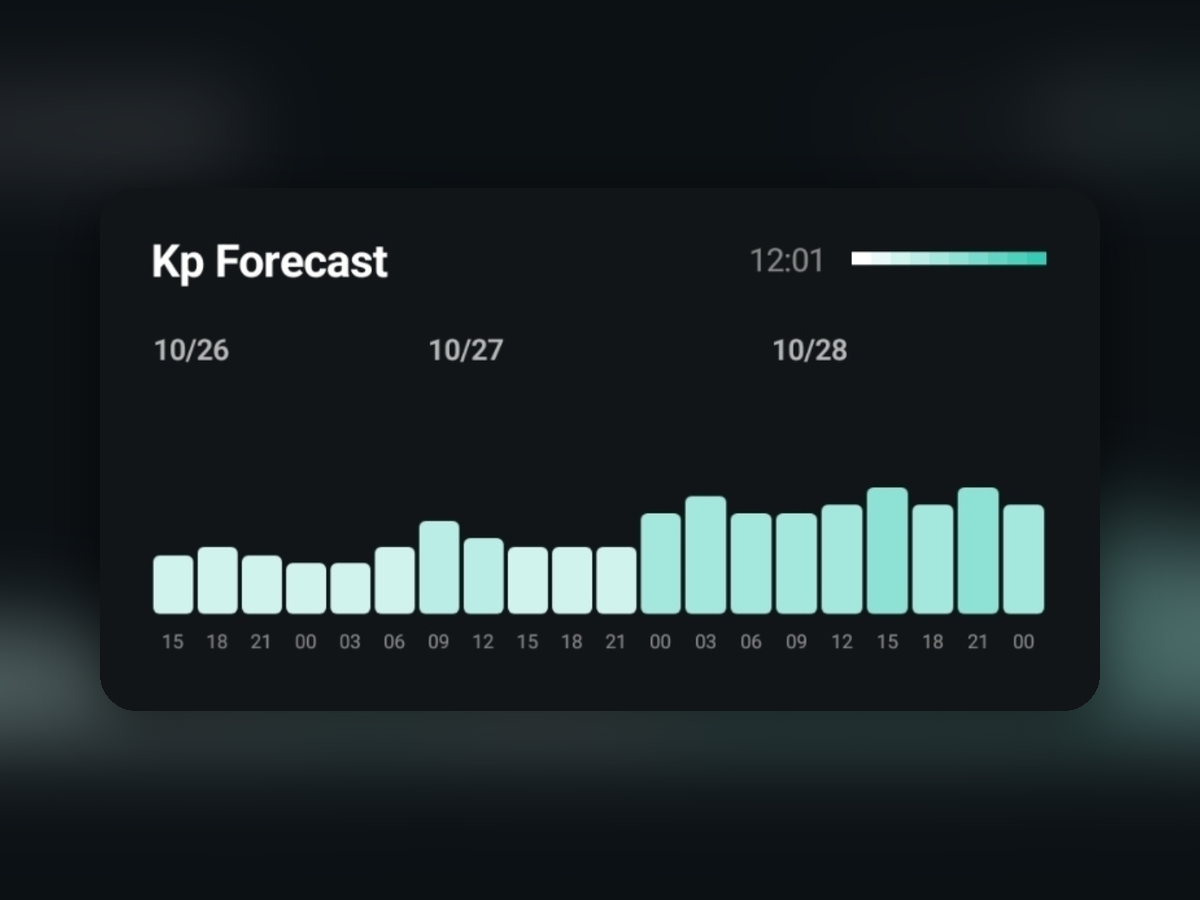
In NOAA's 3-day forecast, Kp shows up as decimals like 4.67 or 5.33. Kp is actually measured in thirds, so 4.67 means "5−" (one third below 5) and 5.33 means "5+". In practice, treat 4.67 as almost Kp 5.
Kp is also roughly logarithmic. In NOAA's NCEI conversion table, the ap index (a linear measure of the disturbance) goes from 27 at Kp 4 to 48 at Kp 5 and 132 at Kp 7. One step of Kp is a big jump, not a small nudge.
The G-scale turns Kp into storm levels. By NOAA's definition, Kp 5 is G1, 6 is G2, 7 is G3, 8 and 9− are G4, and 9 is G5. The 3-day forecast comes in three-hour blocks in UTC, so convert them to local time to see whether the active hours fall during your night. I covered how to read the forecast and set up alerts in Get Geomagnetic Storm Forecast Alerts.
Why Kp alone isn't enough
Kp is a three-hour global average, which makes it great for the big picture but not for what happens over your head tonight. That was the first thing I learned chasing the aurora with my own app: Kp alone can't predict the substorms that suddenly make the sky light up.
So this is how I use Kp:
- A few days out: check the 3-day Kp forecast for nights that reach the Kp line for my location.
- That night: watch the real-time solar wind and Bz (the north–south part of the interplanetary magnetic field). When Bz turns south (negative), the aurora can come in stronger than the Kp forecast suggested.
- Right before heading out: check the clouds and the moon. NOAA says the most active aurora usually shows up between 10 PM and 2 AM local time.
I explained how to read solar wind and Bz in How to Interpret Aurora Conditions.
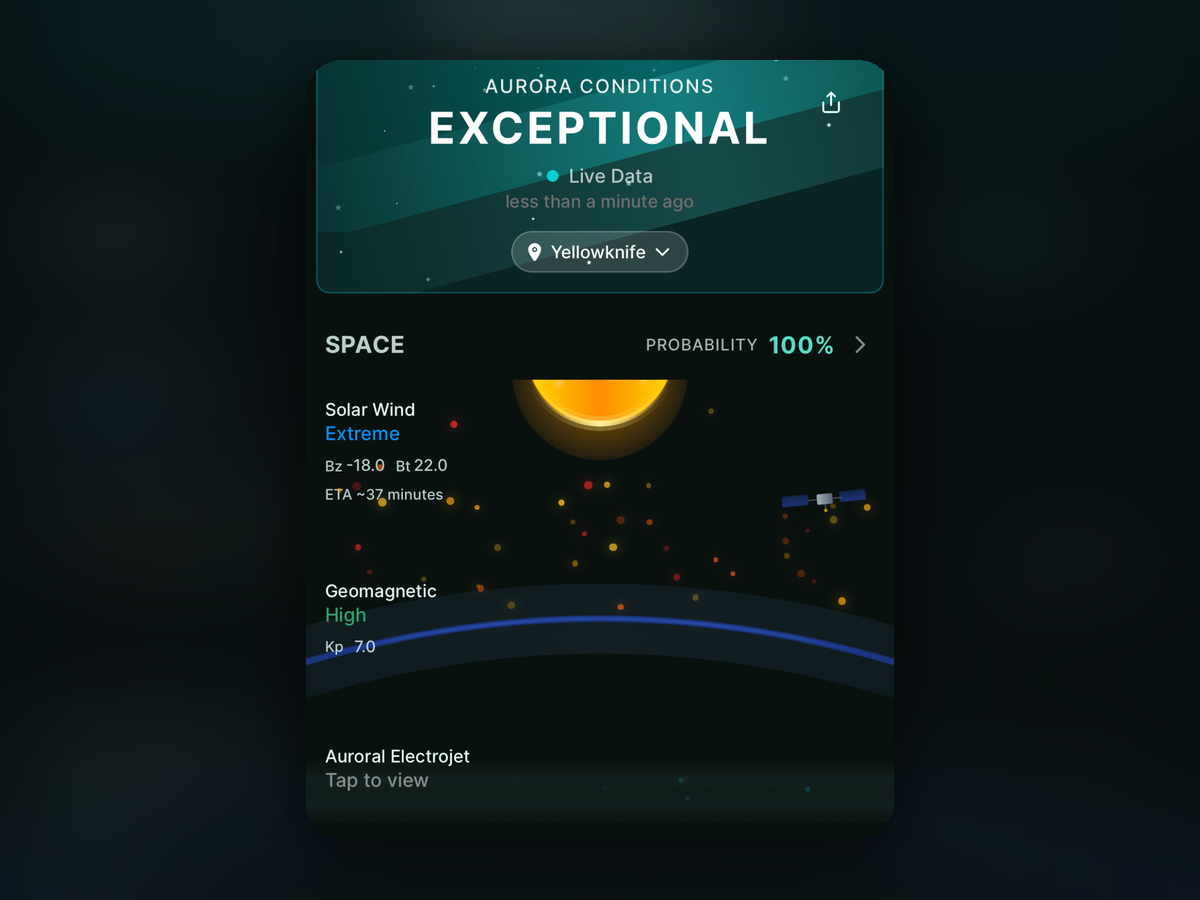
Aurora Eos follows the same order on screen: solar wind and Bz at the top, geomagnetic activity and Kp below that, then ground conditions like clouds and darkness. Everything is calculated for your location, so the same Kp can give a different result in Tromsø than in Helsinki.
Summary
Kp tells you how far south the aurora can reach. At destinations like Tromsø, Yellowknife, Abisko, Rovaniemi, and Reykjavík, Kp 0–2 is enough, so check the clouds and the moon before you worry about Kp. In Helsinki or Oslo, watch for Kp 5 (G1). In Edinburgh or Seattle, wait for Kp 7 (G3) or higher.
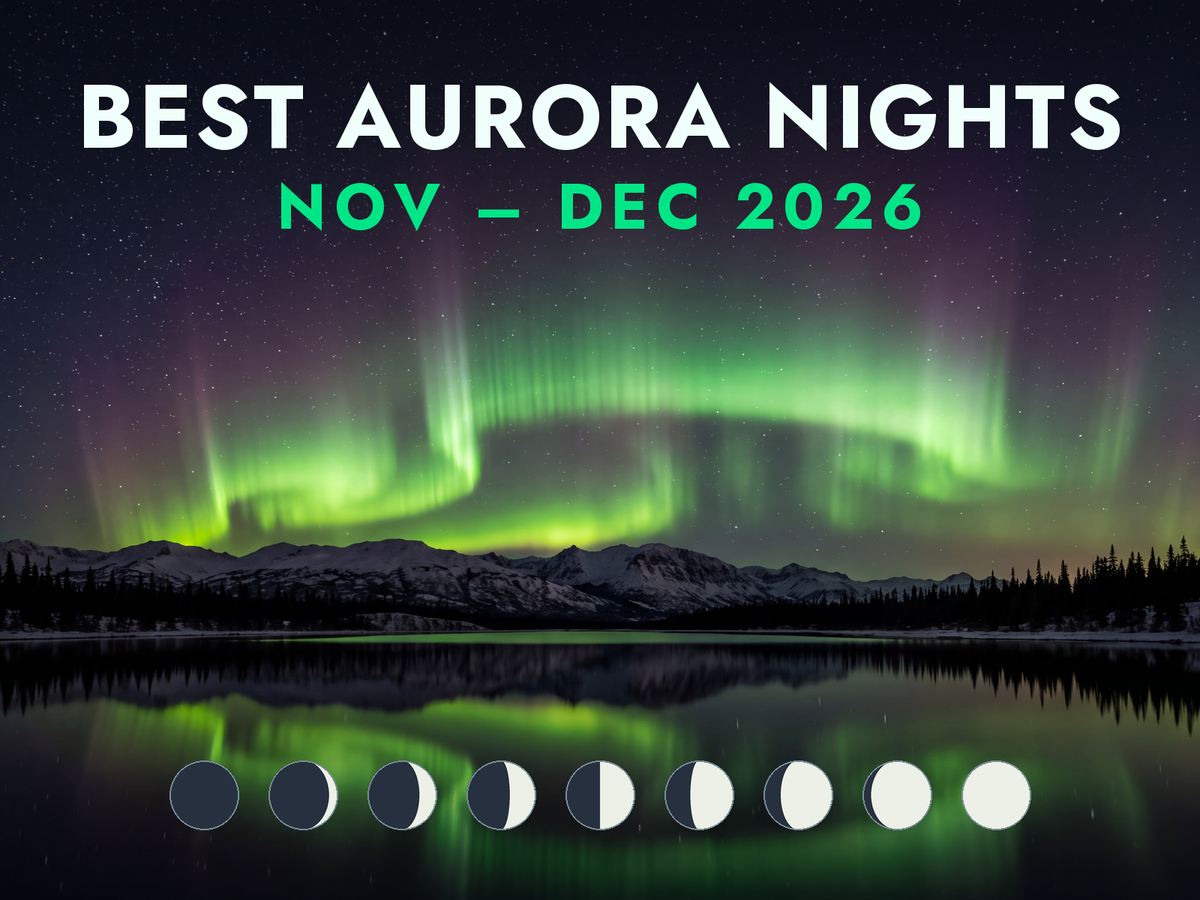
If you're planning a November trip, pick your dates by the moon first. In November 2026, the longest stretch of moon-free dark nights runs from November 5 to 14. I listed the dates in Best Time to See the Northern Lights in November and December 2026. Once your dates are set, save your destination in Aurora Eos and keep an eye on Kp and the solar wind together.
References
- NOAA SWPC — Tips on Viewing the Aurora: Kp and the auroral oval, Kp 3–4 under the oval, the 1,000 km view, and the 10 PM–2 AM window
- NOAA SWPC — Planetary K-index: how Kp is calculated and how it maps to the G-scale
- UC Berkeley SSL — Auroral Kp Help: magnetic latitude of visible aurora for Kp 0–9
- NOAA NCEI — Geomagnetic kp and ap Indices: Kp in thirds and the ap conversion table
- AACGM-v2 (aacgmv2): magnetic latitude calculations for each city
- NOAA SWPC — G4 (Severe) Storm Levels Reached and NPR: the November 2025 G4 storm and low-latitude aurora