By November, the nights at every major aurora destination are long enough. So the question changes from "when is aurora season?" to "which dates should I actually book?" When I spent months waiting for the northern lights in Canada last year, I learned that aurora hunting comes down to luck and time. You can't choose your luck, but you can choose your time.
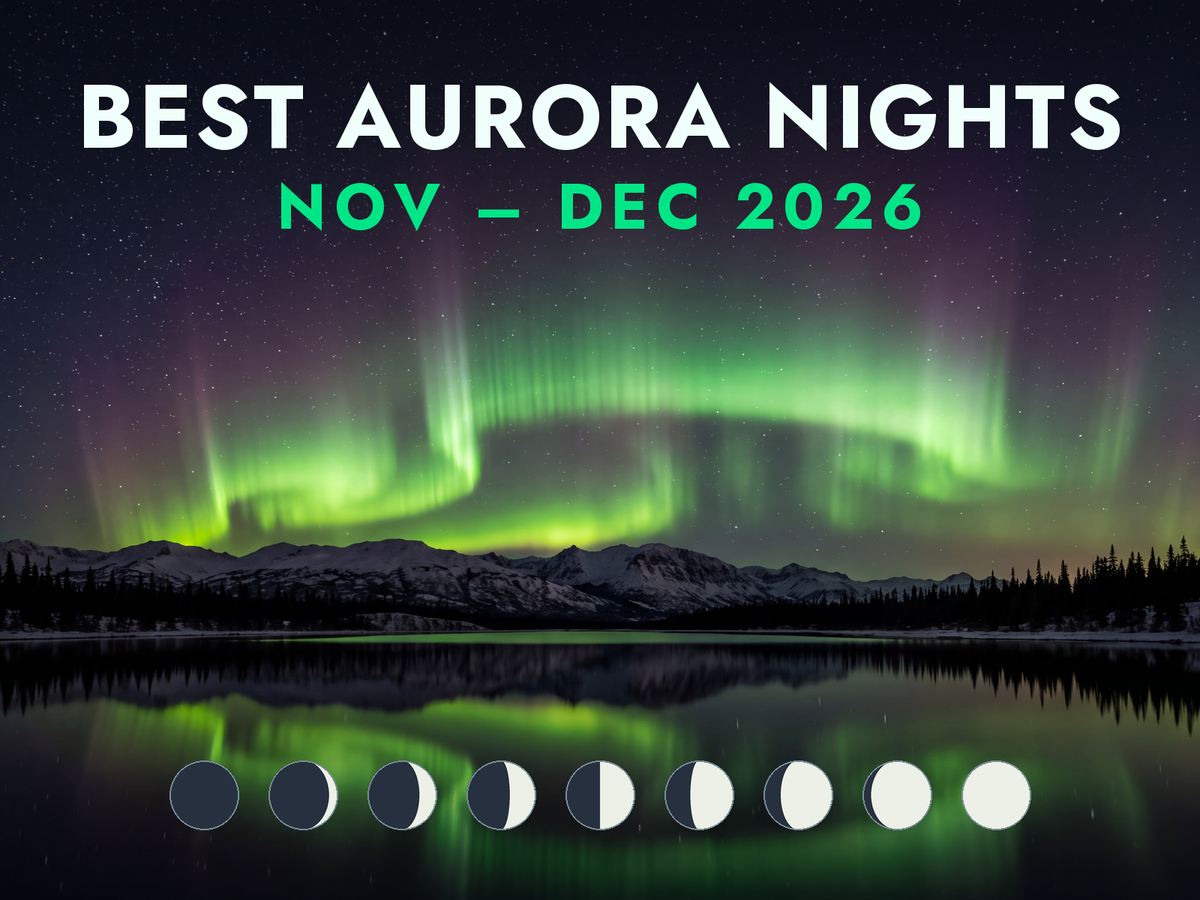
Here's the short answer. If your dates are flexible, start with the nights of November 5–14 and December 4–12, 2026. Be aware that from November 22–27 and December 20–25, a bright moon stays up for the entire dark part of the night. Below is how I worked out those dates, and what to do if a full moon week is the only time you can go.
In November and December, the moon matters more than darkness
Once the midnight sun is over, long nights return quickly at high latitudes. By my calculations, Tromsø gets about 10.8 hours of full astronomical darkness (the sun more than 18° below the horizon) on November 5, rising to about 13.5 hours by mid-December. In Tromsø, the last sunrise of 2026 is on November 27, and the polar night runs from November 28 to January 14, 2027.
With darkness no longer the limiting factor, the moon is the one variable you can plan around before you book. NOAA's Space Weather Prediction Center notes that a full moon reduces the apparent brightness of the aurora, not its actual brightness. Strong displays still shine through moonlight, but the faint and moderate auroras that make up most nights can wash out. Clouds and solar wind only become predictable a few days out. The moon is already on the calendar.
For more on how the midnight sun and polar night shape the season, see Plan Aurora Viewing with Polar Day and Polar Night.
Moon phases, November 2026 to January 2027
All times are in UTC.
- New moon: November 9, 07:02
- Full moon: November 24, 14:53
- New moon: December 9, 00:51
- Full moon: December 24, 01:28 (the 2026 supermoon, right on Christmas Eve)
- New moon: January 7, 2027, 20:24
What really matters is not the phase itself but whether the moon is above the horizon during your dark hours. A thin crescent that sets early in the evening leaves the rest of the night dark. Around full moon, the moon rises near sunset and stays up until morning. In midwinter at high latitudes, the full moon rides so high that it may not set at all: in Tromsø, I found the moon stays above the horizon all day around November 24–28 and December 21–25.
The darkest nights and the full moon weeks, by date
I checked six popular aurora destinations (Tromsø, Abisko, Rovaniemi, Reykjavík, Yellowknife, and Fairbanks) night by night, measuring how much of the astronomically dark time the moon spends below the horizon. Each date refers to the night that starts that evening.
Best nights: moon down for 90% or more of the darkness
- November 5–14 (through the 15th in Tromsø, Abisko, and Rovaniemi)
- December 4–12 (through the 13th in Tromsø, Abisko, Rovaniemi, and Reykjavík)
- January 1–10, 2027 (from the 2nd in Reykjavík)
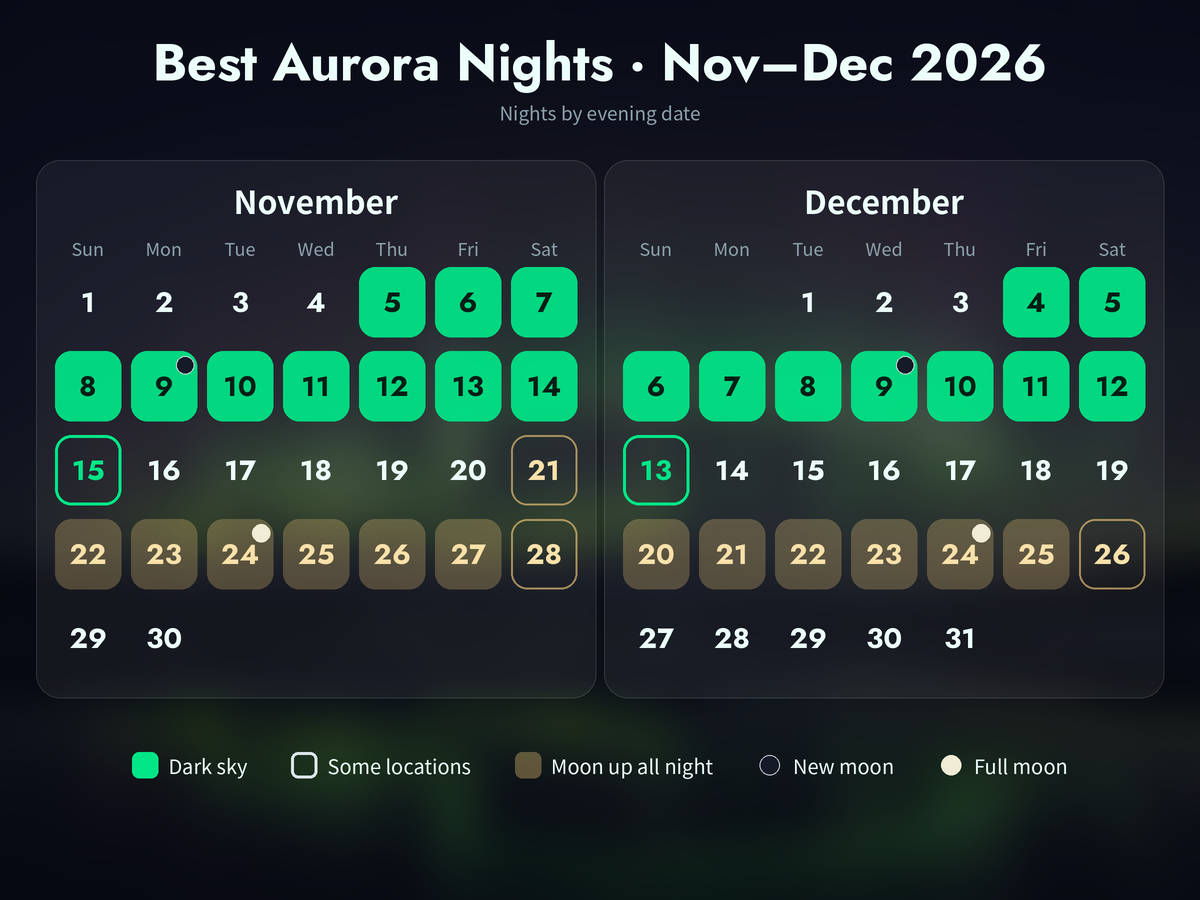
Nights when the moon is up for all of the darkness
- November 22–27 (November 21–28 in Tromsø and Abisko, and from the 21st in Yellowknife and Fairbanks)
- December 20–25 (through the 26th in Tromsø and Abisko)
The six locations differed by a day at most, and my Reykjavík numbers matched a November breakdown published by an Icelandic aurora service. Whichever destination you choose, these dates are a good starting point. If your holiday trip falls in Christmas week, just know that it lines up with the biggest full moon of 2026.
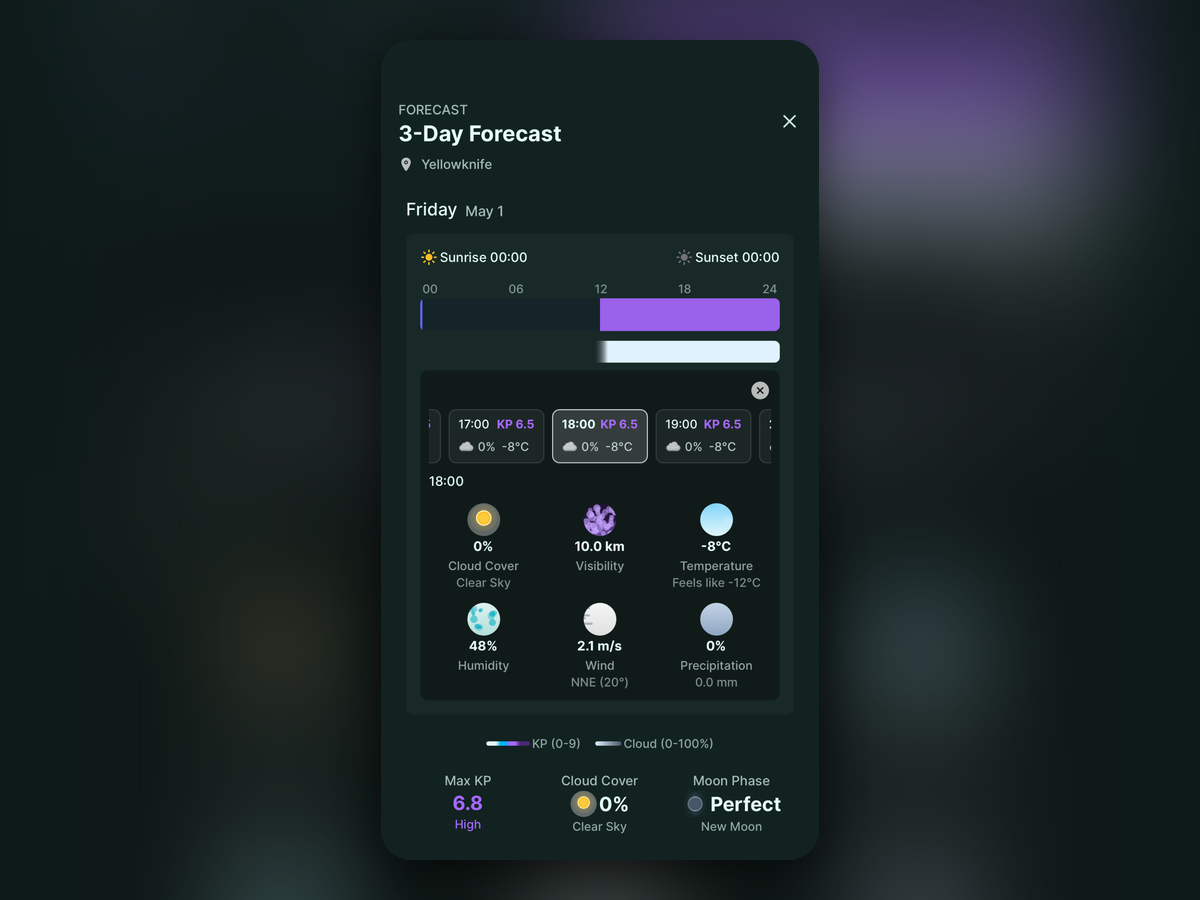
In Aurora Eos, the 3-day forecast shows the moon phase and moonlight condition for each day, right next to max Kp and cloud cover. The location screen also shows moonrise and moonset times. Checking when the moon sets on your trip dates tells you not just which night to go out, but what time to start.
Traveling during a full moon? Here's how to make it work
If your dates are fixed, don't cancel. NOAA points out that if you're in the right place under the aurora, you can see very nice displays even at low activity levels like Kp 3 or 4. Destinations such as Tromsø, which sits beneath the auroral oval, still give you real chances on moonlit nights.
- Give yourself several nights, and go all in on the ones with the highest forecast activity.
- Get as far from town as you can. Moonlight plus light pollution flattens contrast fast.
- Keep the moon behind you and watch the northern sky, where the aurora usually starts. Note when the moon sits low or has set.
- For photography, use the moonlight. It lights up snowy mountains and frozen lakes, which makes for great foregrounds under the aurora.
Pick the dates with the moon, pick the night with the forecast
The moon narrows down your dates. Space weather and clouds decide which night you actually head out. I look at different things depending on how far away the trip is.
A month out: the 27-day outlook
The Sun rotates about once every 27 days. According to NOAA, persistent coronal holes can last through several rotations, sending recurring streams of fast solar wind that can trigger G1–G2 geomagnetic storms. That's why the 27-day outlook is useful for long-range planning. It hints at which dates to watch, but it isn't a forecast for any specific night.
Three days out: Kp and geomagnetic storm forecasts
Solar maximum has passed, but big storms haven't stopped. When NASA and NOAA announced in October 2024 that the Sun had reached its solar maximum period, they noted that fairly significant storms often occur during the declining phase too. On November 12, 2025 (UTC), a G4 (severe) geomagnetic storm pushed the northern lights as far south as Florida and Alabama. Big storms are usually forecast a few days ahead, so turn on alerts. Here's how: Get Geomagnetic Storm Forecast Alerts.
On the night: solar wind, Bz, clouds, and timing
On the night itself, check real-time solar wind speed, Bz, and cloud cover together. If those numbers are new to you, start with How to Interpret Aurora Conditions. NOAA says the most active aurora usually appears between 10 p.m. and 2 a.m. local time.
One more thing: daylight saving time ends on October 25 in Europe and on November 1 in most of the U.S. and Canada. Because clocks fall back an hour, the same aurora activity shows up an hour earlier on your clock than it did in September. Iceland doesn't observe daylight saving time, so nothing changes there.
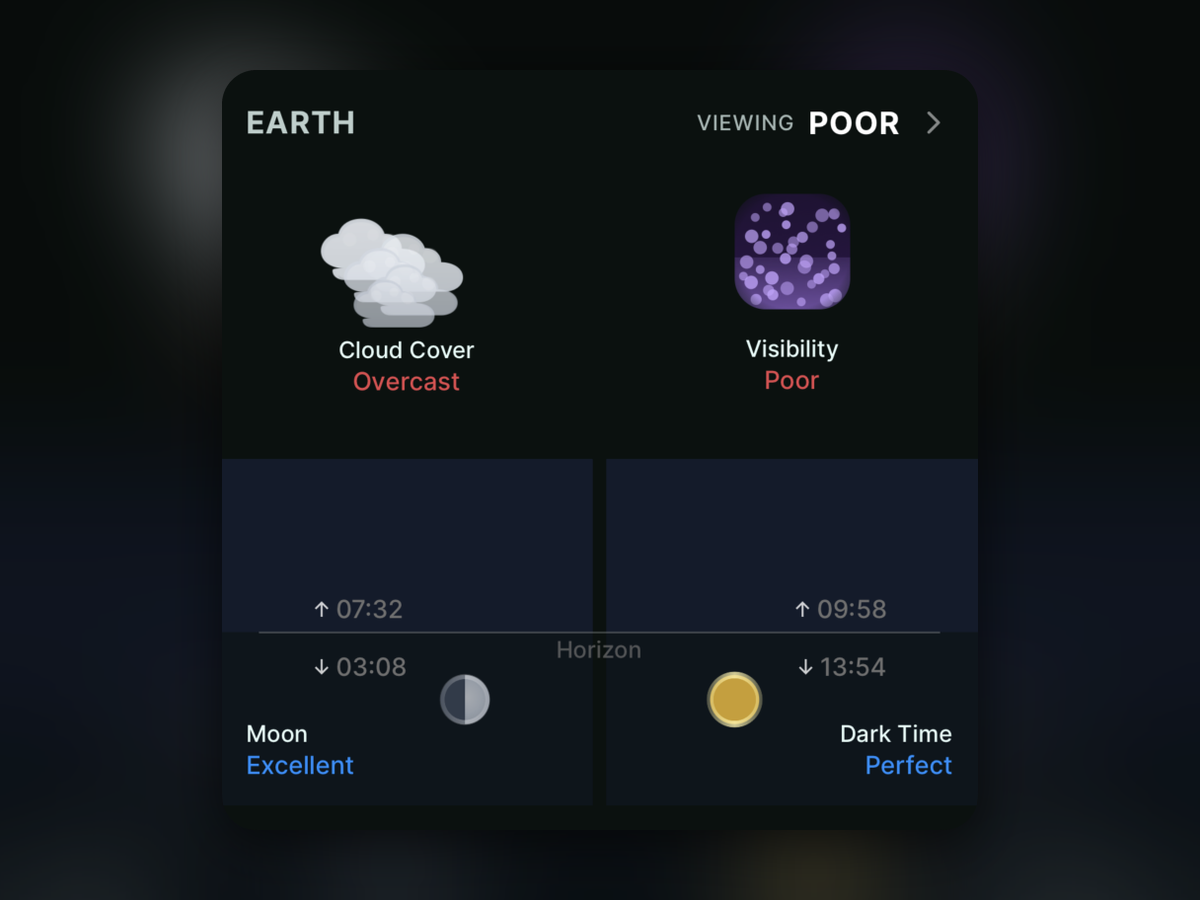
Aurora Eos combines clouds, darkness, moonlight, and visibility into a single 0–100 viewing score and shows it as Excellent, Good, Fair, or Poor. Two nights with the same Kp can be very different depending on the moon and the clouds, so I check this rating first and then dig into the details.
Summary
November and December 2026 bring plenty of darkness to high-latitude aurora destinations, so the moon is the first thing to check when choosing dates. The longest moon-free stretches are November 5–14, December 4–12, and January 1–10, 2027. From November 22–27 and over Christmas, December 20–25, the moon is up all night.
A dark, moonless night still doesn't guarantee an aurora. Choose your dates with the calendar, choose your night with the forecast, and leave the rest to the clouds. If you're planning an aurora trip this winter, save your destination in Aurora Eos and keep an eye on the moon and the forecast together. I hope it helps you catch the night the sky opens up.
Sources
- timeanddate — Moon Phases 2026 (UTC): 2026 new and full moon times, and the December 24 supermoon
- NOAA SWPC — Tips on Viewing the Aurora: moonlight, Kp and location, and the 10 p.m.–2 a.m. viewing window
- NOAA SWPC — Coronal Holes: the 27-day rotation and recurring high-speed solar wind
- NASA — Sun Reaches Maximum Phase in 11-Year Solar Cycle: the solar maximum announcement and storms in the declining phase
- NOAA SWPC — G4 (Severe) Storm Levels Reached and NPR: the November 2025 G4 storm and low-latitude aurora sightings
- Tromsø Winter — Polar Night and Visit Tromsø: the 2026/27 polar night and Tromsø's position under the auroral oval
- Aurora Iceland — Northern Lights in Iceland in November 2026: moon-free darkness in Reykjavík, night by night
- timeanddate — Daylight Saving Time 2026: when DST ends in Europe and North America