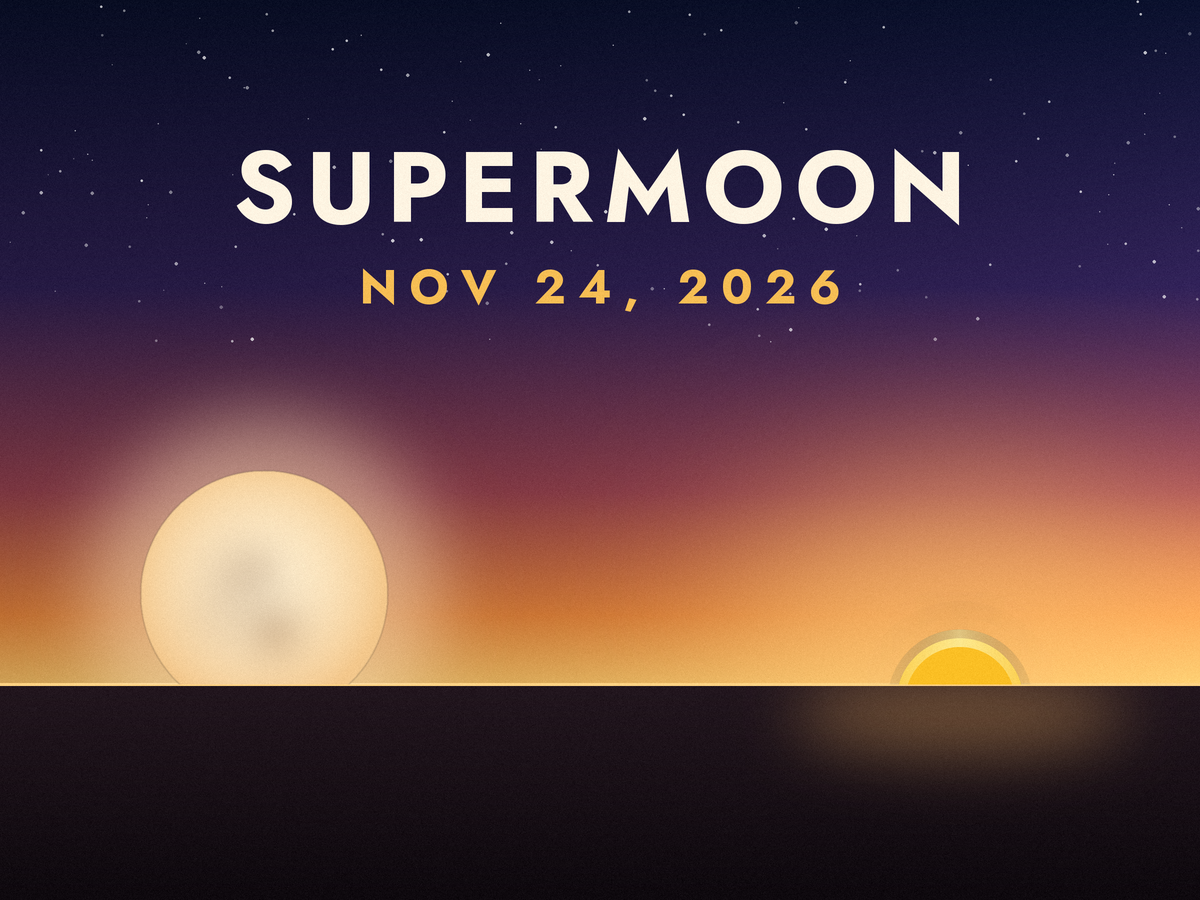
The full moon on November 24, 2026 is a supermoon. It happens close to perigee, the point where the Moon comes nearest to Earth, so it looks a little bigger and brighter than usual. In North America the November full moon is called the Beaver Moon. It's exactly full at 14:53 UTC on November 24 (9:53 AM EST).
The short answer: in New York and Los Angeles, go out on the evening of November 24. London has good moonrises on both the 24th and 25th. In Seoul and Tokyo, the evening of November 25 is best. Those are the evenings when the Moon clears the horizon during golden hour. As before, I calculated the moonrise times for each city myself.
How big is a supermoon?
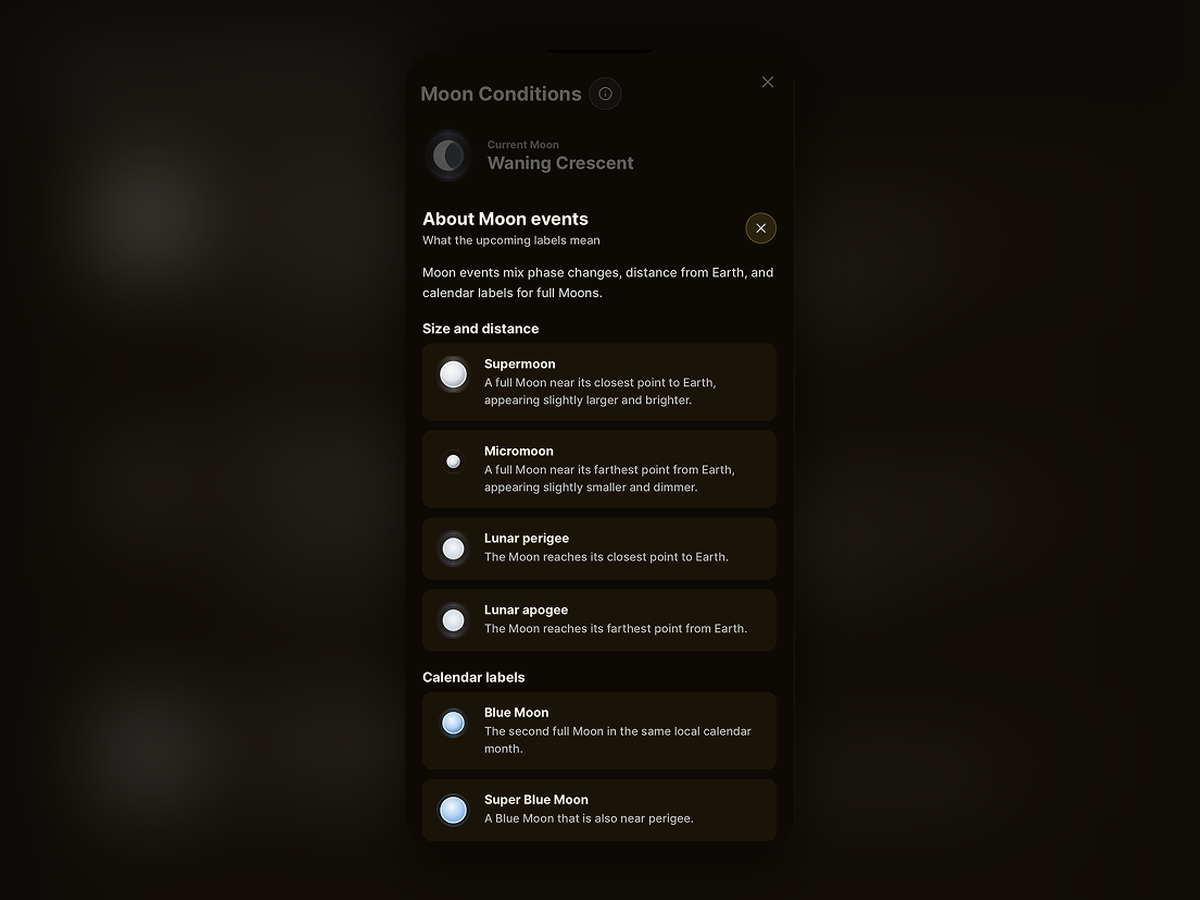
The Moon's orbit is an ellipse, so its distance from Earth changes from month to month. A full moon near the close end of that orbit is called a supermoon. It's not an official astronomy term, and sources draw the line a little differently, but in 2026 the January, November, and December full moons are the ones usually counted.
By my calculation, the November 24 full moon is about 360,765 km away. Compared with the most distant full moon of the year on May 31 (about 406,135 km), it's about 13% wider and about 27% brighter. Perigee itself comes a little over a day later, at 21:15 UTC on November 25.
To be honest, when the Moon is high in an empty sky, that difference is hard to notice by eye. A supermoon looks big mostly when you see it near the horizon next to buildings or mountains. So for a supermoon, what matters isn't just when it's full. It's whether it rises at sunset.
Moonrise vs. golden hour by city
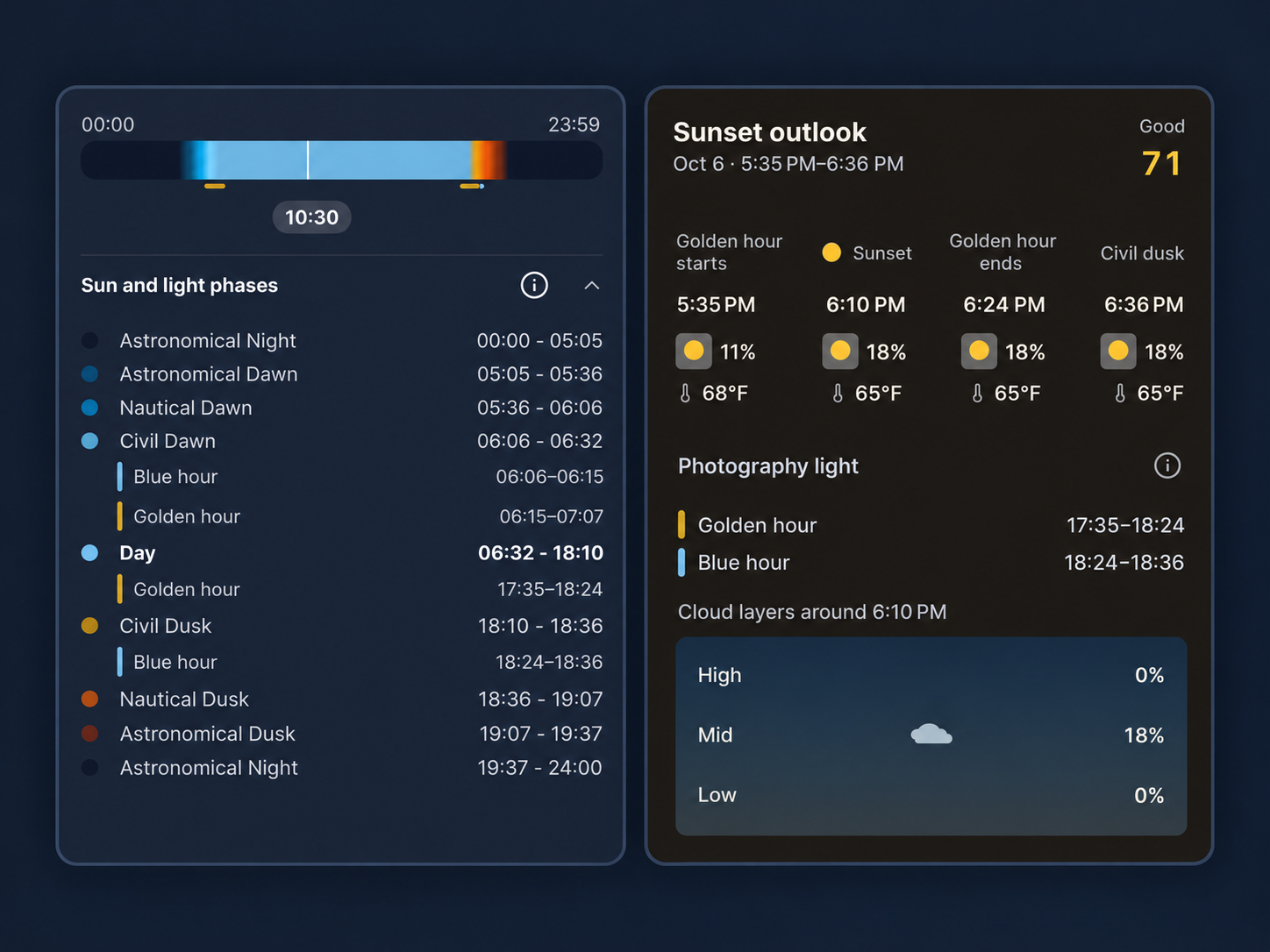
I used the same definitions as in the October Hunter's Moon guide. Golden hour is when the Sun is between 6° above and 4° below the horizon, and blue hour is between 4° and 6° below. All times below are local.
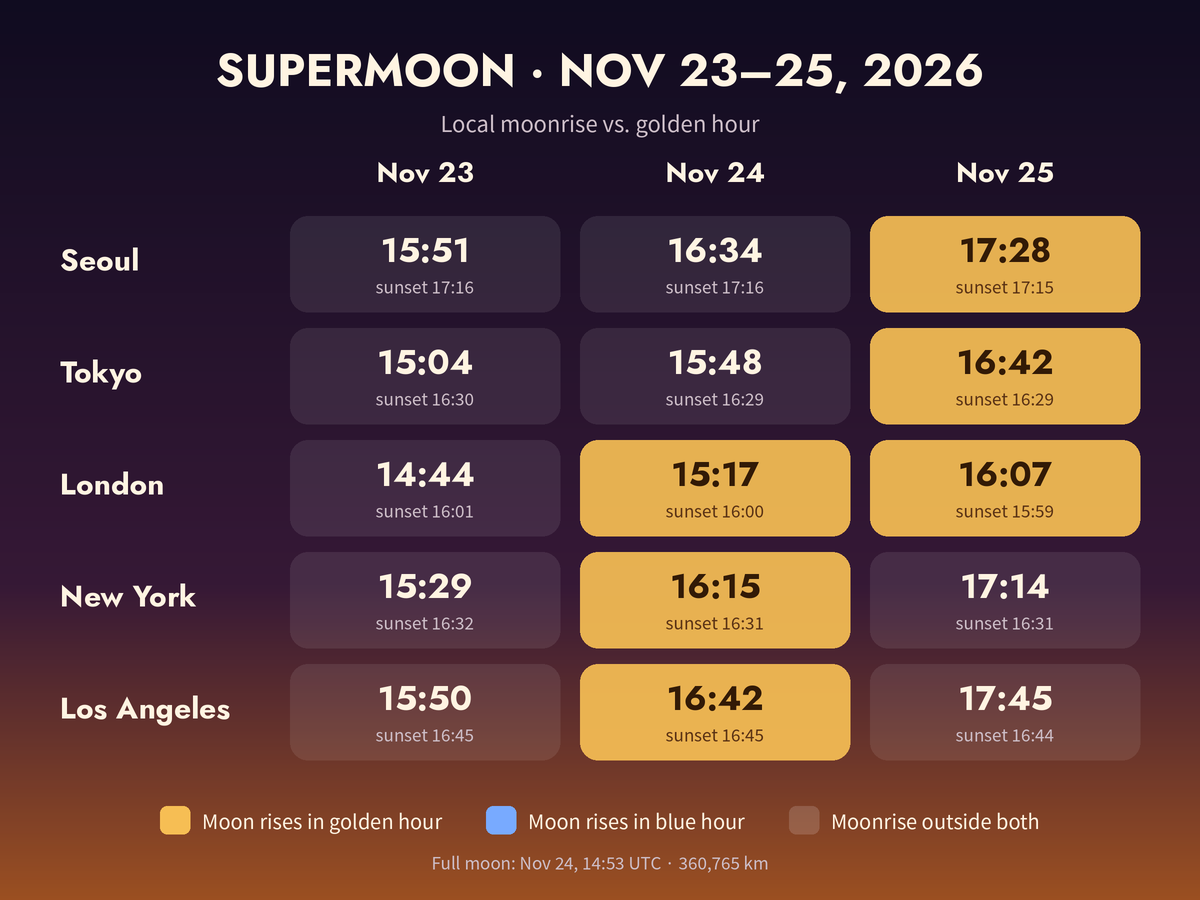
- New York: November 24, moonrise 4:15 PM, sunset 4:31 PM. The Moon rises 16 minutes before the Sun sets.
- Los Angeles: November 24, moonrise 4:42 PM, sunset 4:45 PM. The Sun and Moon touch opposite horizons almost at the same time.
- London: moonrise 3:17 PM on the 24th (sunset 4:00 PM) and 4:07 PM on the 25th (sunset 3:59 PM). Both fall in golden hour.
- Seoul: on the 24th the Moon rises at 16:34, two minutes before golden hour starts, while the sky is still bright. On the 25th it rises at 17:28, 13 minutes after sunset, at the tail end of golden hour.
- Tokyo: November 25, moonrise 16:42, sunset 16:29. Like Seoul, the 25th is the better evening.
In the Americas the exact full moon falls on the morning of the 24th, so the Moon that rises that evening is the roundest you'll get. In East Asia it's full late on the 24th, so the Moon on the evening of the 25th is still almost 100% lit.
Where the Moon rises
On November 24 in New York, the Moon rises at an azimuth of about 55°, well north of due east, while the Sun sets in the west-southwest (about 243°). The Moon rises farther north than it did in October, so a spot that worked for the Hunter's Moon may not line up this time.
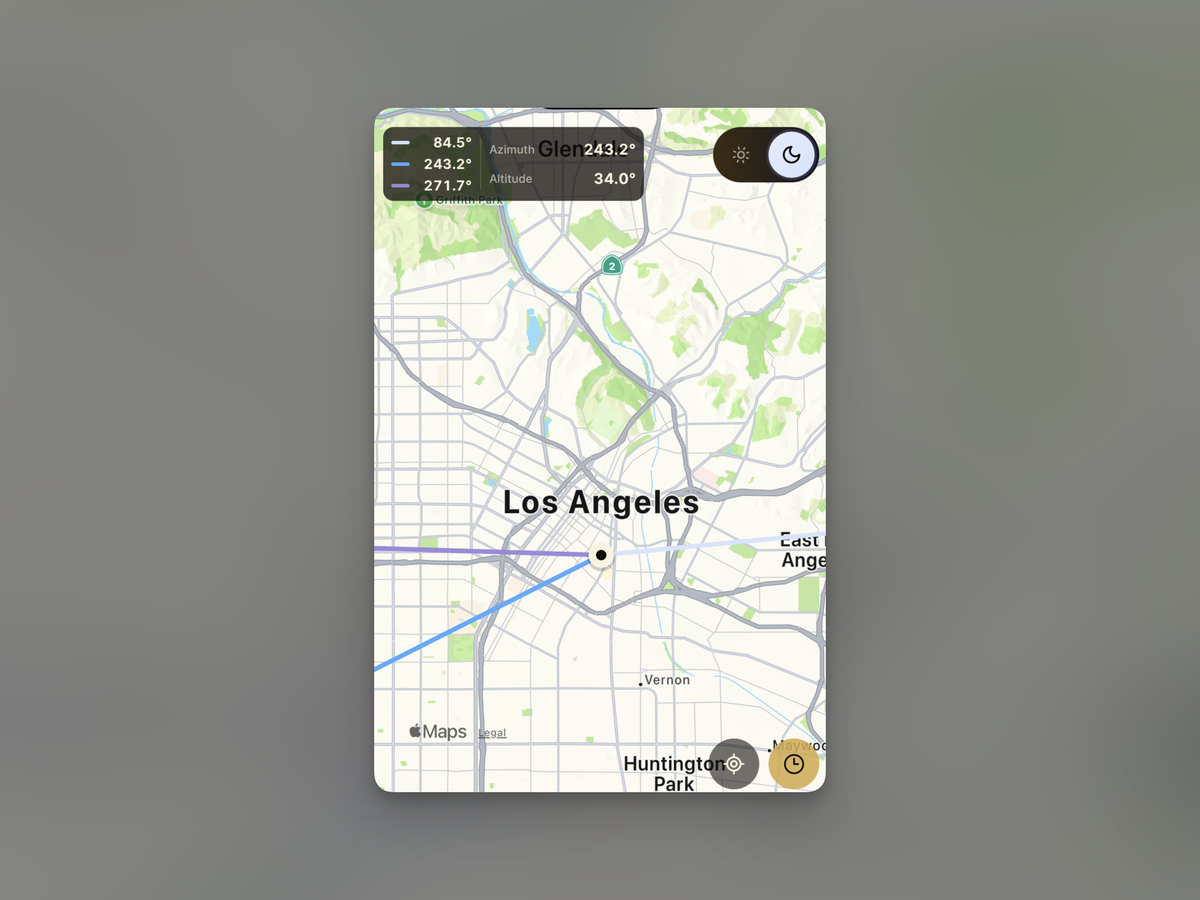
I set the date in Golden Horizon's moon direction map, then check whether the subject I want sits along the moonrise line. You want yourself and your subject lined up on that line.
Tips for making the supermoon look big
- Shoot from far away with a telephoto lens. Even a supermoon becomes a small dot on a wide-angle lens. The farther you are from your subject, the bigger the Moon looks next to it.
- Aim for the first 10–20 minutes after moonrise. A freshly risen Moon looks orange, and there's still light on the landscape, so it's easier to get both in one frame.
- Pick a spot with a clear eastern horizon. Buildings or hills delay the moment the Moon actually appears.
- Expose for the Moon and take lots of frames. As the sky darkens, the Moon blows out to white quickly.
I covered planning the light in A Photographer's Guide to Perfect Golden Hour Shots, and how to check moon events like supermoons and Blue Moons in the app in Check Planet, Blue Moon, and Solar Eclipse Events.
Missed it? There's December 24
If November doesn't work out, you get another chance a month later. The December 24 full moon, the Cold Moon, is the closest supermoon of 2026, at about 356,740 km. It's the biggest full moon of the year, rising on Christmas Eve. Scouting your spot and composition in November makes December much easier.
Summary
The November 2026 supermoon is on November 24. In New York and Los Angeles, watch the evening of the 24th. London works on the 24th and 25th. In Seoul and Tokyo, the Moon rises in the east-northeast just after sunset on the 25th. Line up the date and direction ahead of time, and you can catch one of the biggest full moons of the year over the landscape. Hope the weather cooperates.
References
- timeanddate — Seoul Moonrise and Moonset, November 2026: moonrise times and azimuth cross-check
- The Old Farmer's Almanac — What Is a Supermoon?: 2026 supermoon dates and distances
- BBC Sky at Night Magazine — Supermoons 2026: the three supermoons of 2026 and the Beaver Moon
- Moonblink — Moon Data Table 2026: full moon distances and perigee