The 2026 winter solstice arrives on December 21. The exact moment is 20:50 UTC, which is 3:50 p.m. in New York and 12:50 p.m. in Los Angeles. In New York the day lasts 9 hours 15 minutes, the shortest of the year.
But when I worked out the sunset times around it, something did not line up. The earliest sunset in New York is on December 7, two weeks before the solstice. The latest sunrise comes on January 4, two weeks after. By solstice day, sunsets are already getting later. Here is why, and when to be outside if you want to catch the low winter sun.
New York on the solstice
- Sunrise: 7:17 a.m., azimuth 121° (east-southeast)
- Sunset: 4:32 p.m., azimuth 239° (west-southwest)
- Daylight: 9 h 15 min
- Sun height at midday: about 26°
This is the day the sun rises and sets farthest south. In June it came up in the northeast and went down in the northwest; now it crosses the southern sky in a short, low arc. Even at noon it climbs only 26°, so shadows stay long all day and the light turns warm soon after 3 p.m.
The earliest sunset is December 7
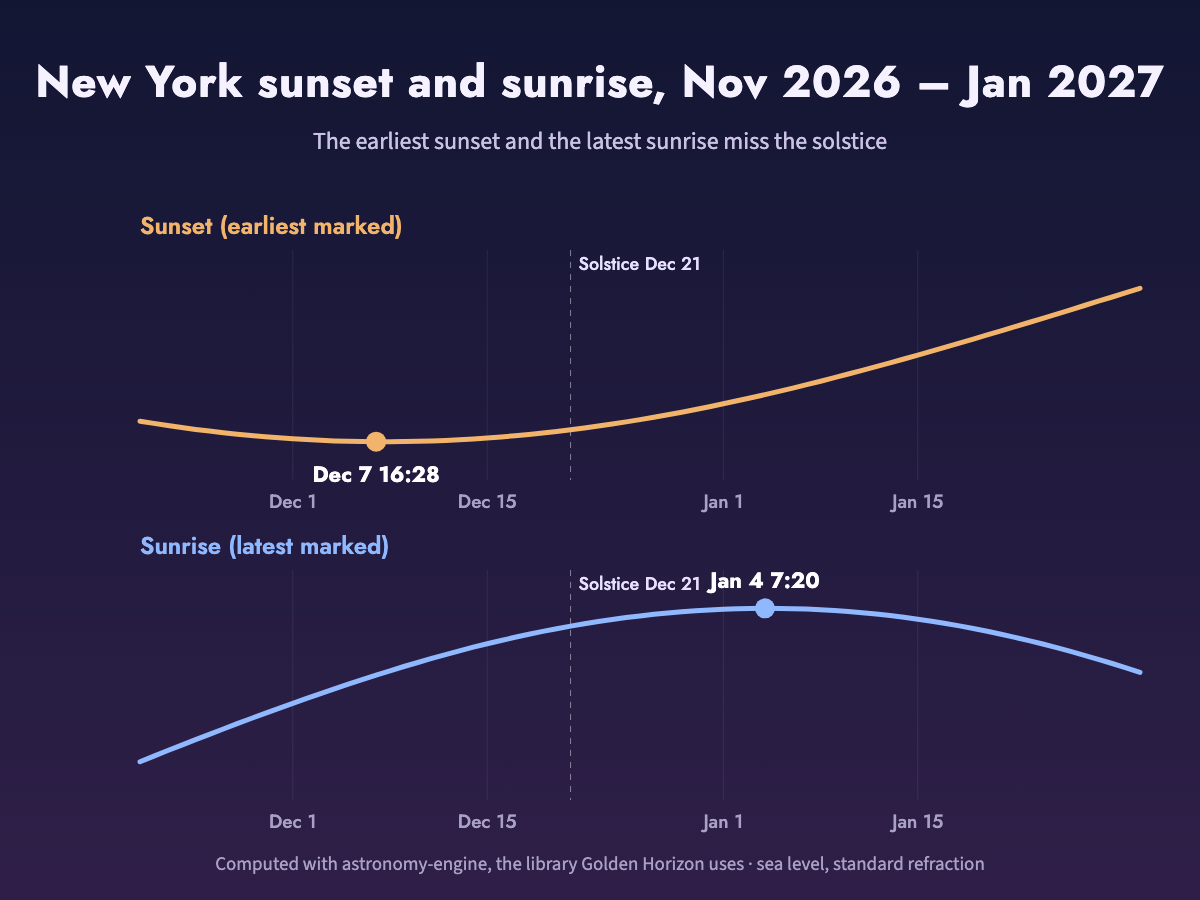
- Earliest sunset: December 7, 4:28 p.m. After that, sunsets get later by a few dozen seconds a day.
- Solstice: December 21, sunset 4:32 p.m., sunrise 7:17 a.m.
- New Year's Day: sunset 4:39 p.m., sunrise 7:20 a.m.
- Latest sunrise: January 4, 7:20 a.m. The first week of January is within seconds of it.
So "the days get longer after the solstice" is true for day length, but it is not how the commute feels. Evenings have been brightening since early December, while mornings keep getting darker into January. Nearly all the daylight gained in late December lands in the evening.
Why the solstice and the extremes don't match
Day length depends on how far south the sun is. The clock time of sunrise and sunset also depends on solar noon, the moment the sun crosses due south. In December, solar noon slips later by almost 30 seconds a day. Earth's orbit is an ellipse and Earth moves fastest near perihelion in early January; combined with the tilt of its axis, that shifts solar noon. Astronomers call the difference the equation of time.
By early December the day is shrinking slowly enough that the later solar noon wins. Sunsets start moving later before the solstice, and sunrises keep moving later for weeks after it.
The gap depends on latitude. London, much farther north, has its earliest sunset on December 12 and latest sunrise on December 30, close to the solstice. Taipei, much farther south, has them on November 29 and January 14. The closer you are to the equator, the less the day length changes, and the more the solar noon shift shows.
Solstice golden hour: low and long
I count golden hour as the sun between 6° above and 4° below the horizon, and blue hour as 4° to 6° below. New York, December 21:
- Morning blue hour: 6:45–6:57 a.m.
- Morning golden hour: 6:57–8:00 a.m.
- Evening golden hour: 3:48–4:50 p.m.
- Evening blue hour: 4:50–5:02 p.m.
Because the sun rises and sets at a shallow angle, each golden hour lasts about an hour. In winter it overlaps the commute, which is the season's one gift to photographers. Blue hour, on the other hand, is over in about 12 minutes.
Sunset is west-southwest (239°), so a building or ridge to the southwest will hide the sun early even if your western view looks open. I set the date to December 21 on the sun direction map in Golden Horizon and check what sits along the sunset line first. How that works is in Find the sun direction on the map.
Other cities
- London: December 21, sunrise 8:04 a.m., sunset 3:53 p.m., 7 h 50 min of daylight. The sun only reaches 15° at midday. Evening golden hour runs from 2:51 to 4:18 p.m.
- Los Angeles: December 21, sunrise 6:55 a.m., sunset 4:48 p.m., 9 h 53 min. Earliest sunset December 4 (4:43 p.m.), latest sunrise January 7 (6:59 a.m.).
- Tokyo: December 22, sunrise 6:48 a.m., sunset 4:32 p.m., 9 h 45 min.
- Seoul: December 22, sunrise 7:43 a.m., sunset 5:17 p.m., 9 h 34 min.
- Sydney: the same moment is the summer solstice. December 22 has 14 h 25 min of daylight, the longest of the year.
Summary
The 2026 winter solstice is December 21 (20:50 UTC), with 9 h 15 min of daylight in New York. The earliest sunset, though, was December 7 (4:28 p.m.), and the latest sunrise is still to come on January 4 (7:20 a.m.). If you chase sunsets after work, early December is the darkest; if you chase sunrises, January mornings keep getting later. For the first morning of the year, see First sunrise of 2027. December also has the Christmas Eve supermoon and the Geminid meteor shower.
All times were computed with astronomy-engine, the library Golden Horizon uses, for sea level with standard refraction. Terrain and elevation can shift them by a minute or two.
References
- timeanddate — New York Sunrise and Sunset, December 2026: cross-check for sunrise and sunset times
- timeanddate — December Solstice: the solstice moment
- Wikipedia — Equation of time: why solar noon drifts