2027 in three lines: one supermoon, on January 22; no total or partial lunar eclipse all year; and a total solar eclipse on August 2 with up to 6 min 23 s of totality at greatest eclipse, though it's not visible from Korea or East Asia.
The Quadrantids and Eta Aquariids get dark skies. The Perseids and Geminids get a bright Moon. I computed every number with Skyfield (JPL DE421 ephemeris), checked meteor peaks against the IMO 2027 calendar and eclipses against NASA's Fred Espenak tables. All times are UTC.
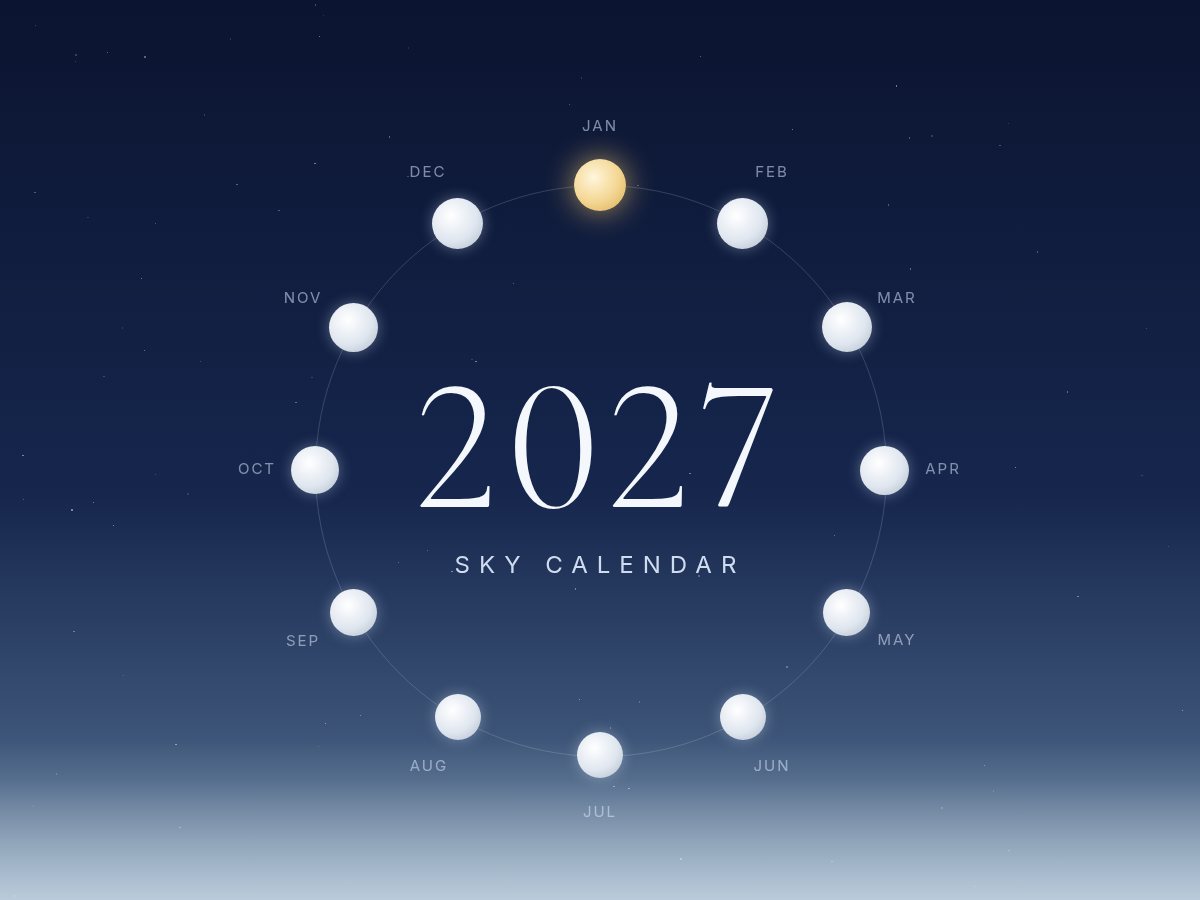
Every full moon in 2027
There are twelve full moons, exactly one per month, so no month has a "blue moon" in 2027 (in UTC or in Korea time). The closest is January 22 and the farthest is July 18.
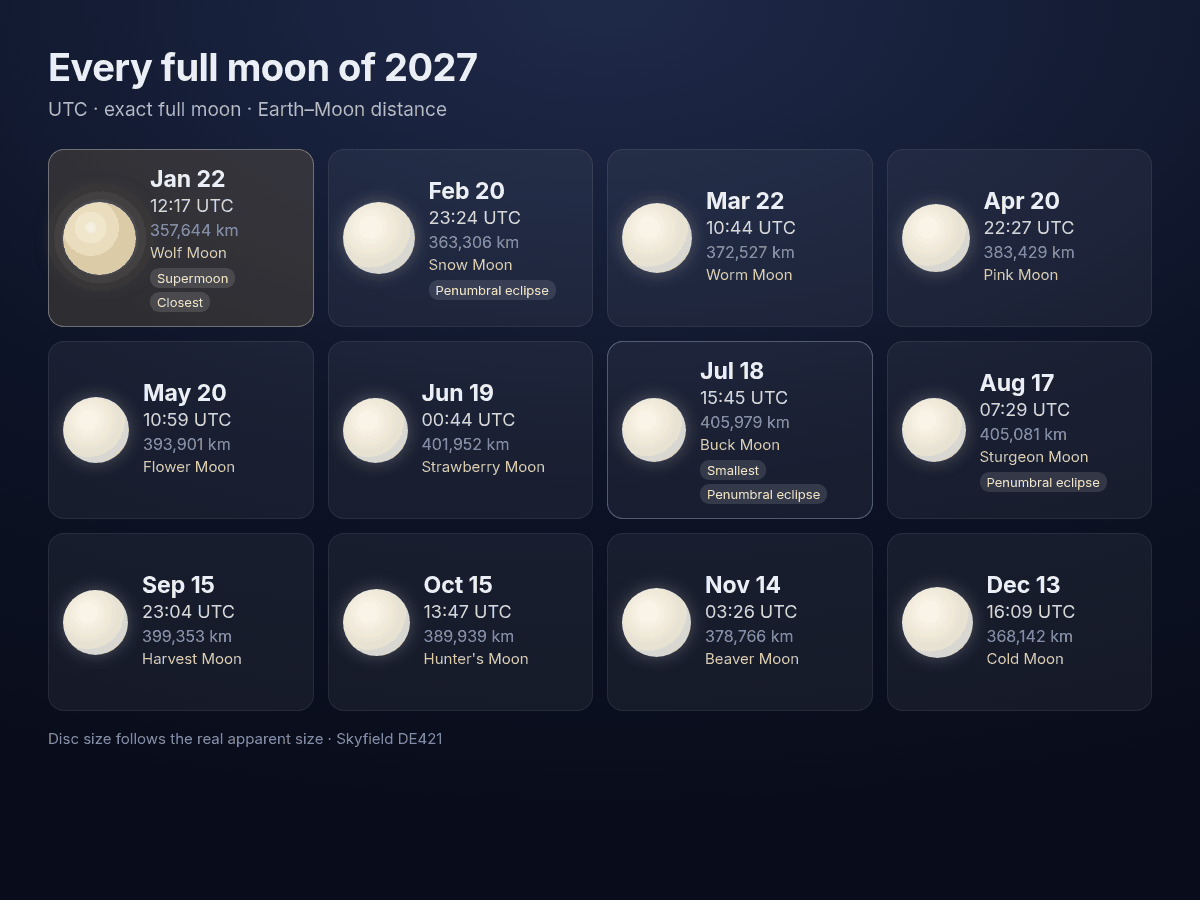
- Jan 22, 12:17 Wolf Moon (357,644 km, closest)
- Feb 20, 23:24 Snow Moon (363,306 km)
- Mar 22, 10:44 Worm Moon (372,527 km)
- Apr 20, 22:27 Pink Moon (383,429 km)
- May 20, 10:59 Flower Moon (393,901 km)
- Jun 19, 00:44 Strawberry Moon (401,952 km)
- Jul 18, 15:45 Buck Moon (405,979 km, farthest)
- Aug 17, 07:29 Sturgeon Moon (405,081 km)
- Sep 15, 23:04 Harvest Moon (399,353 km)
- Oct 15, 13:47 Hunter's Moon (389,939 km)
- Nov 14, 03:26 Beaver Moon (378,766 km)
- Dec 13, 16:09 Cold Moon (368,142 km)
September's is the Harvest Moon because it's the full moon nearest the September equinox. October's full moon is the Hunter's Moon.
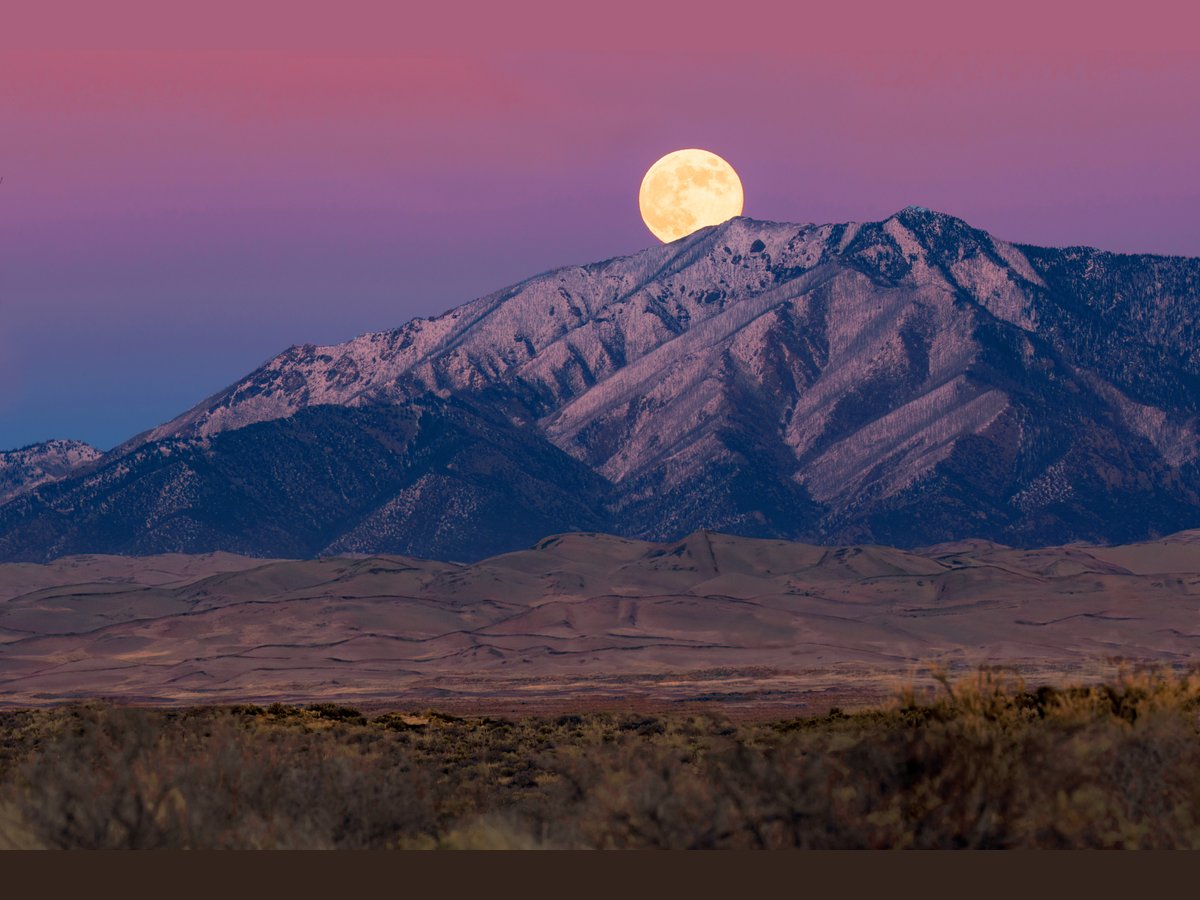
A practical tip: the best full moon photo is usually taken the evening the Moon rises near sunset, not at the exact full moon instant. The sky still has some light, so the landscape and the Moon both expose well. For city moonrise times, see the January Wolf Moon post.
One supermoon: January 22
At 357,644 km, the January 22 full moon is the closest of 2027. With a distance cutoff (within about 360,000 km) it's the only supermoon of the year. With the broader "within 90% of perigee" definition, the February 20 full moon (363,306 km) counts too.
The January 22 Moon looks about 14% wider and about 29% brighter than the July 18 one (405,979 km). The December 24, 2026 supermoon (356,738 km) is nearly the same size, a month earlier; see the Cold Moon post.
Meteor showers: which ones are worth it in 2027
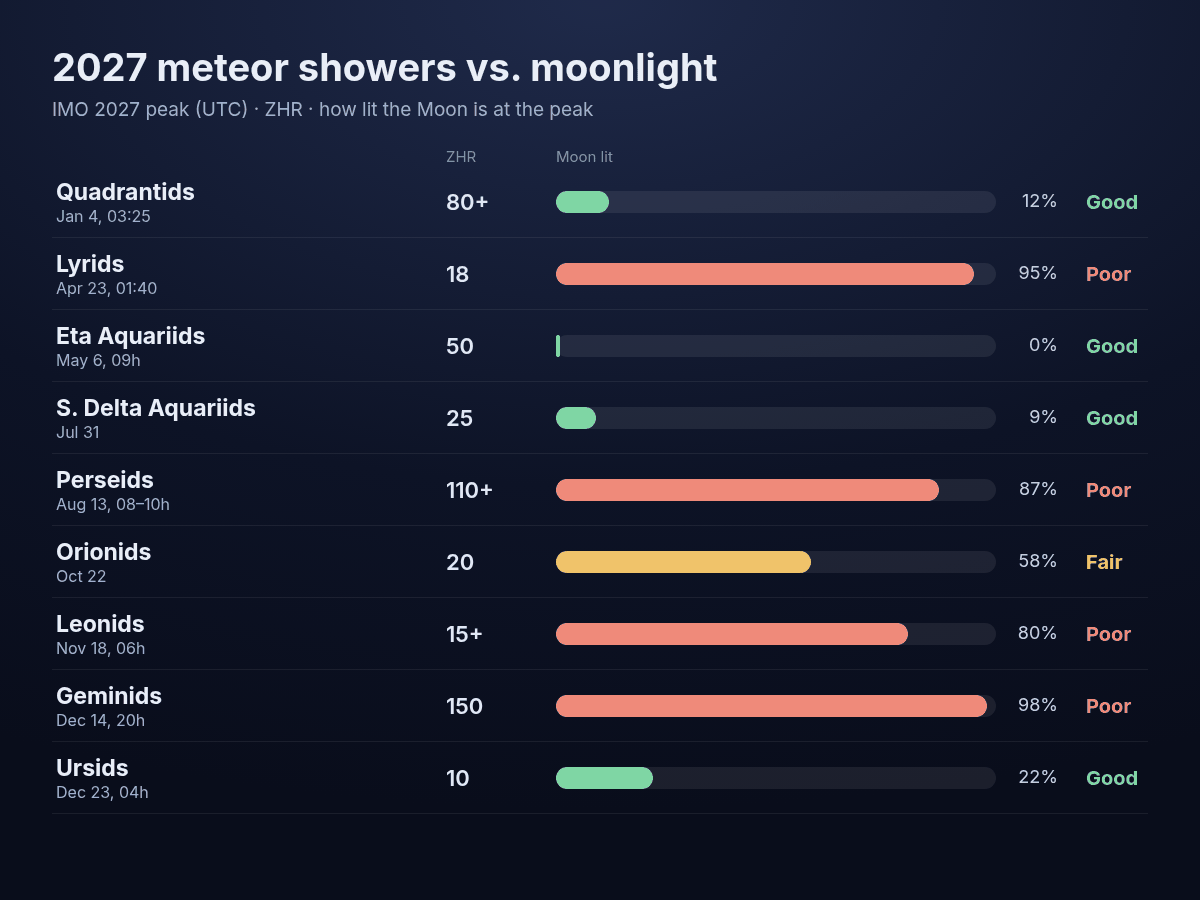
Peaks and ZHR are from the IMO 2027 calendar. I added the Moon's illuminated fraction at each peak time.
Good
- Quadrantids: Jan 4, 03:25 UT, ZHR 80+, Moon 12%. See the Quadrantid post.
- Eta Aquariids: May 6, about 09h UT, ZHR 50, New Moon the same day.
- Southern Delta Aquariids: Jul 31, ZHR 25, Moon 9%.
- Ursids: Dec 23, about 04h UT, ZHR 10, Moon 22%.
Fair
- Orionids: Oct 22, ZHR 20, Moon 58% and waning. In Seoul the Moon doesn't rise until 22:06 local time on Oct 21, so the early night is dark.
Poor
- Leonids: Nov 18, about 06h UT, ZHR 15+, Moon 80%.
- Lyrids: Apr 23, 01:40 UT, ZHR 18, Moon 95%. The peak falls shortly after the full moon, the worst case.
- Perseids: Aug 13, 08-10h UT, ZHR 110+, Moon 87% and waxing. From Seoul the Moon sets at 01:31 local time on Aug 13 and astronomical dawn starts at 04:07, leaving roughly 01:30-04:00. The next night: moonset 02:28, dawn 04:08.
- Geminids: Dec 14, about 20h UT, ZHR 150, Moon 98%. The Moon is up all night in Seoul on Dec 14-15. The IMO says the full moon "severely disturbs visual observations."
In a bright-Moon year, watch after moonset, or put the Moon behind you or behind a building. The brightest meteors still show through.
Eclipses: no total lunar eclipse this year
The only lunar eclipses are three penumbral ones. There's no total or partial lunar eclipse in 2027.
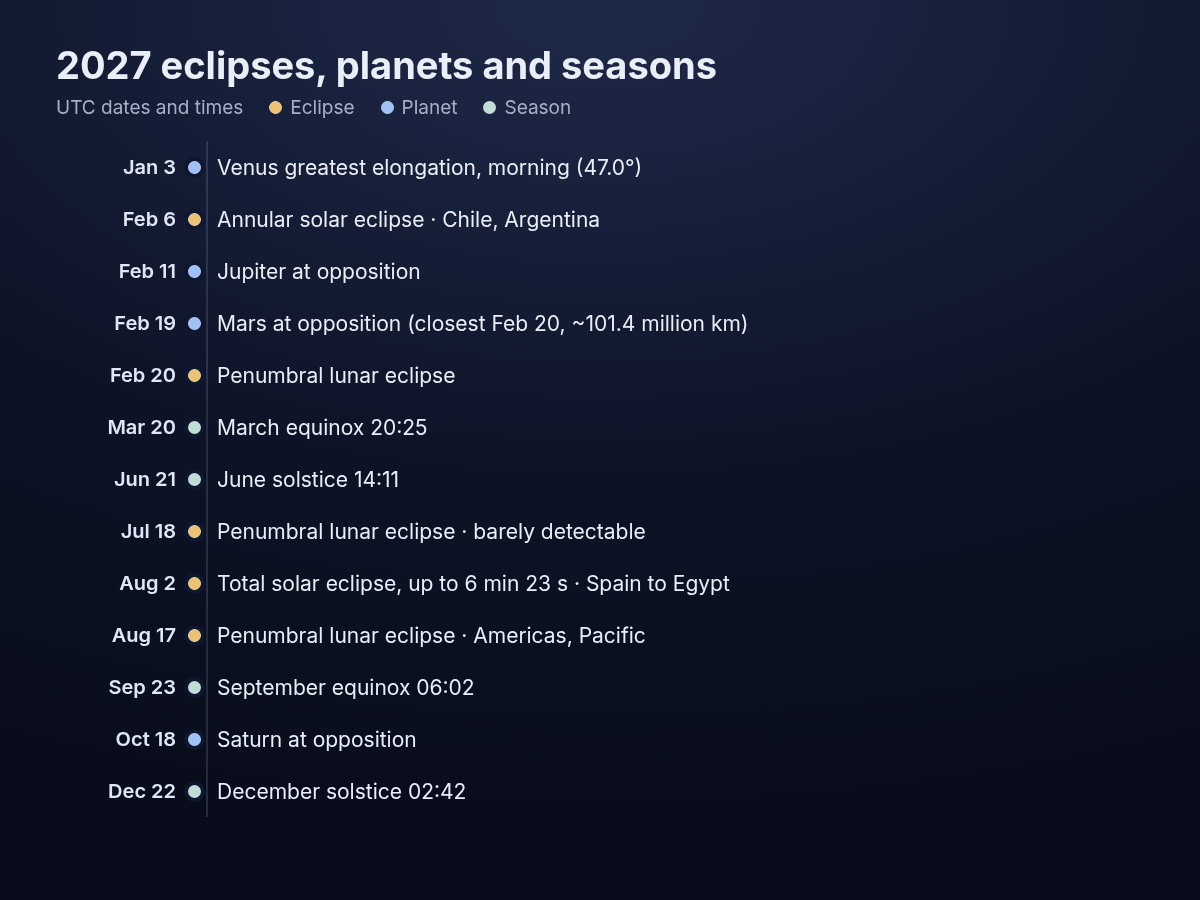
- Feb 6 annular solar eclipse: greatest at 16:00 TD (NASA lists eclipse times in Terrestrial Time, about a minute ahead of UTC), annularity up to 7 min 51 s. The path crosses Chile, Argentina and the Atlantic.
- Aug 2 total solar eclipse: greatest at 10:07 TD, totality up to 6 min 23 s. The path crosses Morocco, Spain, Algeria, Libya, Egypt, Saudi Arabia, Yemen and Somalia. A partial eclipse is visible from Africa, Europe, the Middle East, and west and south Asia. If you travel for one sky event in 2027, make it this one. It's not visible from Korea or East Asia.
- Feb 20 penumbral lunar eclipse: greatest at 23:14 TD. Umbral magnitude is -0.057, so it just misses the umbra. NASA lists it as visible from the Americas, Europe, Africa and Asia.
- Jul 18 penumbral lunar eclipse: greatest at 16:04 TD, penumbral magnitude 0.002, practically undetectable.
- Aug 17 penumbral lunar eclipse: greatest at 07:15 TD, visible from the Pacific and the Americas.
The next real lunar eclipses are partial ones on January 12 and July 6, 2028, then a total one on December 31, 2028 (greatest at 16:53 TD), visible from Europe, Africa, Asia, Australia and the Pacific. If you travel for August 2, use certified solar filters (ISO 12312-2) for every partial phase. Regular sunglasses are not safe.
Planets and the seasons
- Jan 3, 17:58 Venus at greatest western elongation, 47.0 degrees from the Sun. In early January it's easy to find in the east before sunrise.
- Feb 11, 00:28 Jupiter at opposition.
- Feb 19, 15:50 Mars at opposition. Closest approach is Feb 20, 00:08, at about 101.4 million km (0.678 AU). It's a distant opposition, so Mars shows a smaller disc in a telescope than at a close one.
- Oct 18, 00:35 Saturn at opposition.
Jupiter and Mars reach opposition within nine days of each other, which makes February a good month for evening planets.
Seasons: March equinox Mar 20, 20:25, June solstice Jun 21, 14:11, September equinox Sep 23, 06:02, December solstice Dec 22, 02:42. For the start of the year, see the 2026 winter solstice post and the first sunrise of 2027 post.
How I keep track of it
I check the month view in Golden Horizon. The monthly highlights screen lists that month's full moon, planet meetups and dark-sky windows, and picking a date shows that night's moonrise, moonset and direction. The planet, blue moon and eclipse events post covers how the event cards work.
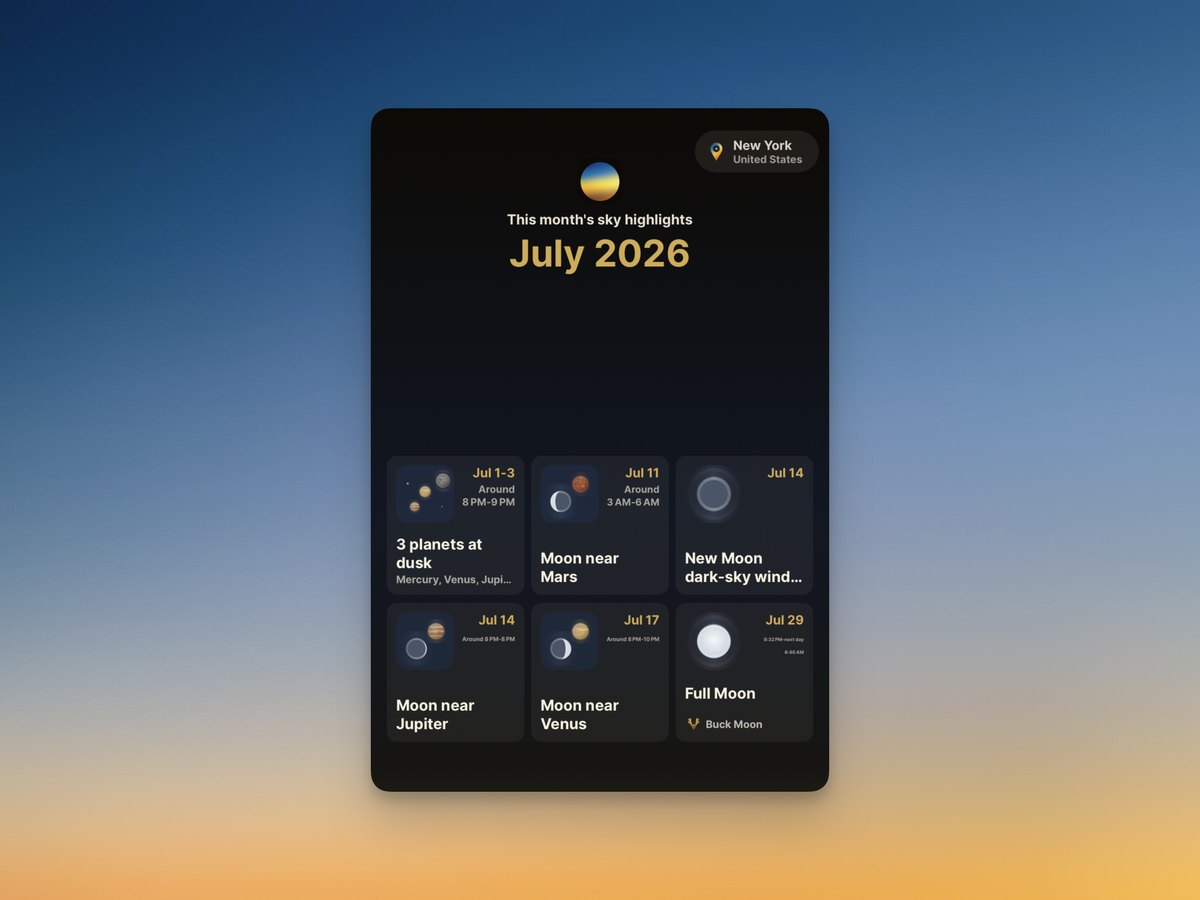
Dates worth putting in your calendar now: the night of January 3–4, the pre-dawn hours around May 6, the evening of January 22 and, if you're travelling, August 2.
Sources
- IMO — 2027 Meteor Shower Calendar: meteor shower peaks and ZHR
- NASA — Solar Eclipses 2021-2030: solar eclipses
- NASA — Lunar Eclipses 2021-2030: lunar eclipses
- Eclipse Predictions by Fred Espenak, NASA's GSFC
- Photo: NPS/Patrick Myers, Great Sand Dunes National Park and Preserve (public domain), via Wikimedia Commons